

Hello! (@chiropiyo0331) here.
This time I’m introducing “Nyoshin no Sato Hibikino” in Ikaho Onsen, Gunma Prefecture.
Step onto its vast grounds of about 15,000 tsubo, and a serene space full of Japanese charm spreads out before you!
With beautiful gardens, open-air baths with a wonderful sense of openness, and dining rooms where you can savor seasonal flavors, it’s truly an inn worthy of being called an “adults’ hideaway.”
In this article, the author, who actually stayed with one night and two meals, thoroughly reviews the following points!
- The facilities and gardens that make use of the vast grounds
- Impressions of the hot springs, where you can enjoy the “Golden Bath” and “Silver Bath”
- The full menu of the lavish dinner and breakfast enjoyed at leisure in a private room
“I want to stay at Hibikino, but what’s the actual atmosphere like?” “I want to know the quality of the food and hot springs in detail!”
For anyone with those questions, this is a real stay report more useful than a guidebook. Please read to the end.
- Who Is Ikaho Onsen Nyoshin no Sato Hibikino Right For?
- Access to Ikaho Onsen Nyoshin no Sato Hibikino
- Overview of Ikaho Onsen Nyoshin no Sato Hibikino
- Large Bath and Open-Air Bath at Ikaho Onsen Nyoshin no Sato Hibikino
- Dinner at Ikaho Onsen Nyoshin no Sato Hibikino
- Breakfast at Ikaho Onsen Nyoshin no Sato Hibikino
- My Impressions of Staying at Ikaho Onsen Nyoshin no Sato Hibikino
Who Is Ikaho Onsen Nyoshin no Sato Hibikino Right For?
Ikaho Onsen in Shibukawa, Gunma, where Ikaho Onsen Nyoshin no Sato Hibikino is located, is a nationally famous hot spring area, bustling with visitors year round thanks to its atmospheric 365 stone steps, the Ikaho Ropeway, Mt. Haruna, and many other attractions.
Around Ikaho Onsen there are about 70 hot spring inns, but when you try to find a place to stay, it’s hard to decide where to stay.
I chose Ikaho Onsen Nyoshin no Sato Hibikino, of course, to sightsee in Ikaho and enjoy Ikaho Onsen, and having actually stayed there, the people this inn suits are as follows.
• Want to stay at a hot spring inn that feels like Ikaho Onsen
• Tired of buffets! Want to enjoy kaiseki cuisine
• Looking for a hot spring inn with good access to Ikaho sightseeing spots
I’ll explain each in turn.
① Want to stay at a hot spring inn that feels like Ikaho Onsen
Ikaho Onsen Nyoshin no Sato Hibikino has a Japanese style, and from the guest rooms to the dining rooms and the passages leading to the hot springs, the whole inn conveys the charm of Ikaho Onsen.
Speaking of Ikaho Onsen, you can enjoy two kinds of hot springs, the Golden Bath and the Silver Bath, and at this inn too you can enjoy them in both the indoor bath and the open-air bath!
② Tired of buffets! Want to enjoy kaiseki cuisine
Dinner at Ikaho Onsen Nyoshin no Sato Hibikino is a lavish kaiseki meal using seasonal ingredients.
The kaiseki meal, committed to seasonal ingredients such as vegetables grown by contracted farmers, morning-picked eggs, local beef, and river fish, lets you choose the main dish from three kinds!! (The photo shows Joshu beef on a ceramic plate.)
You can’t eat in a private room, but the tables are spaced at a certain distance, so there’s no trouble of other groups making it hard to eat!
③ Looking for a hot spring inn with good access to Ikaho sightseeing spots
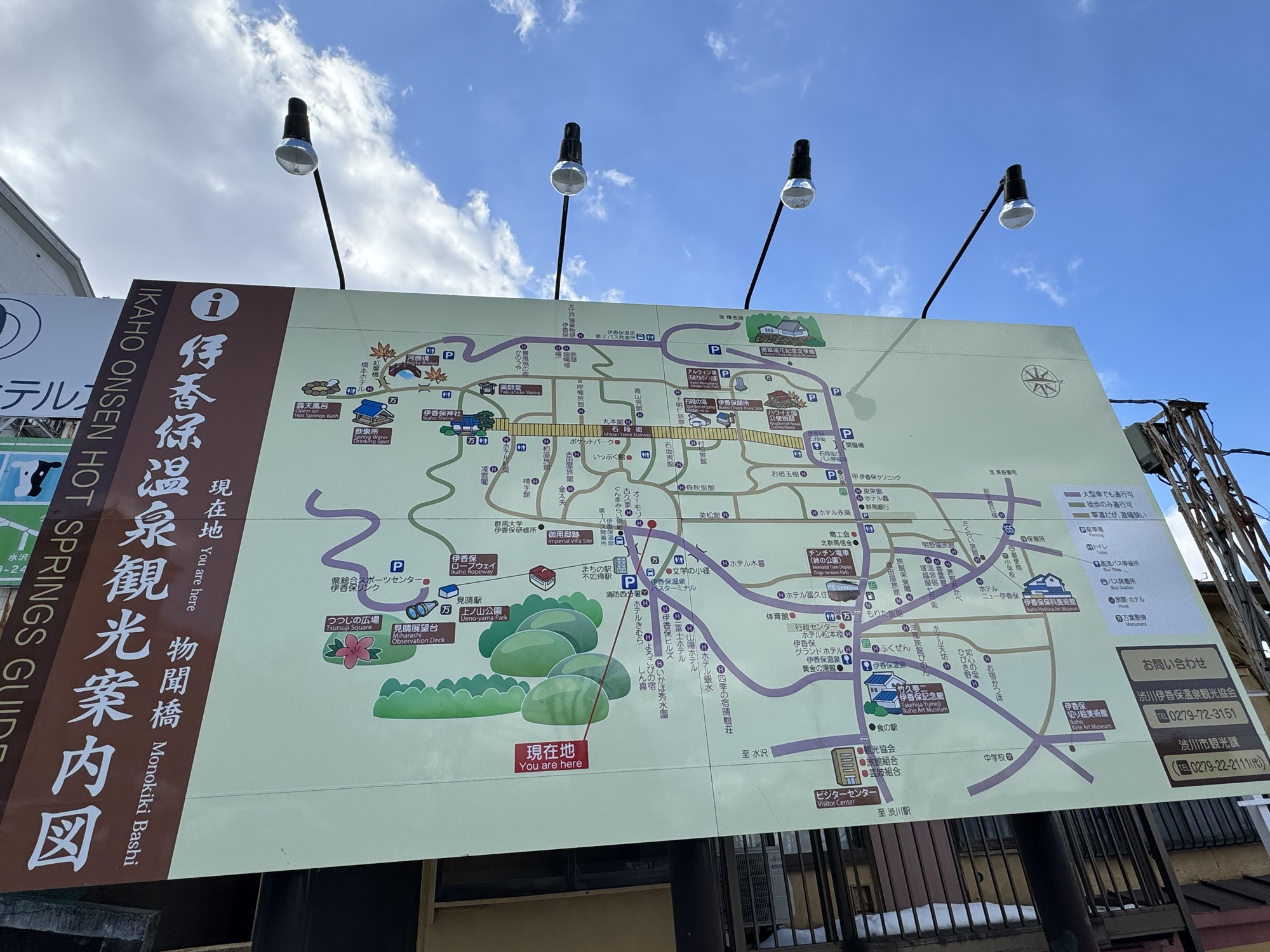
When you come to Ikaho Onsen, hardly anyone just enjoys the hot spring inn and calls it a day, right?
Before and after your stay, a typical Ikaho Onsen trip naturally includes visiting the surrounding sightseeing spots.
It’s not within walking distance, but you can go 3 minutes by car to the stone steps and about 30 minutes by car to Mt. Haruna,
so it’s recommended as a base for sightseeing too.
Access to Ikaho Onsen Nyoshin no Sato Hibikino
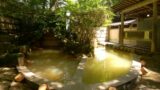
Ikaho Onsen Nyoshin no Sato Hibikino is about 20 minutes by bus from JR Shibukawa Station and about 10 minutes by car from Shibukawa-Ikaho IC on the Kan-etsu Expressway, a hot spring inn where you can enjoy two kinds of free-flowing source water.
In March 2023, the men’s and women’s large baths, where you can enjoy Ikaho’s famous “Golden Bath” and “Silver Bath” from two springs, were renovated, and staying for the hot springs is popular too!



*Prices shown are the lowest weekday rates for 2 guests with breakfast/dinner, before coupons or discounts. Please check the linked page for the latest information.










Overview of Ikaho Onsen Nyoshin no Sato Hibikino
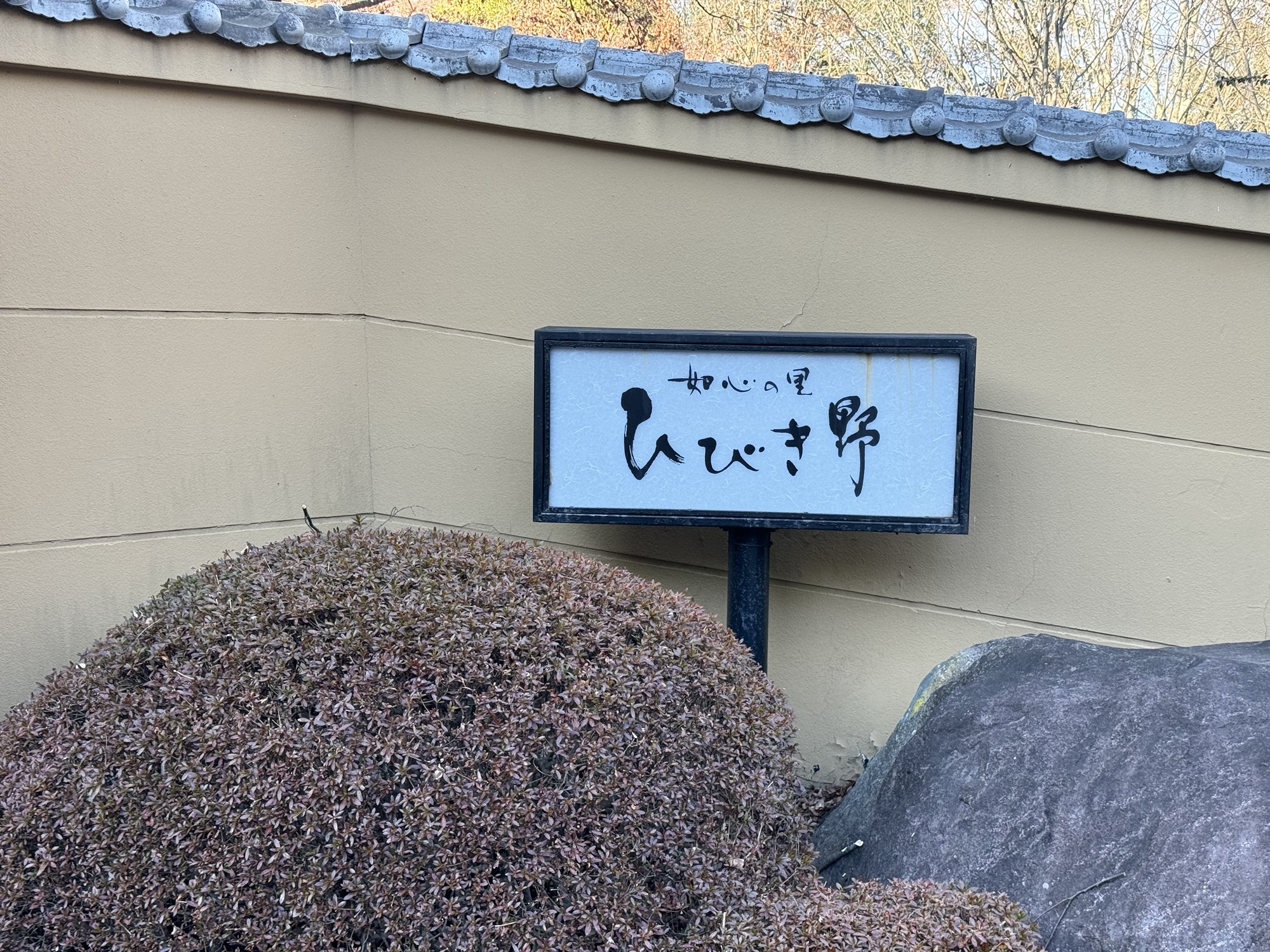
Now let me introduce the details of Ikaho Onsen Nyoshin no Sato Hibikino, where I stayed.
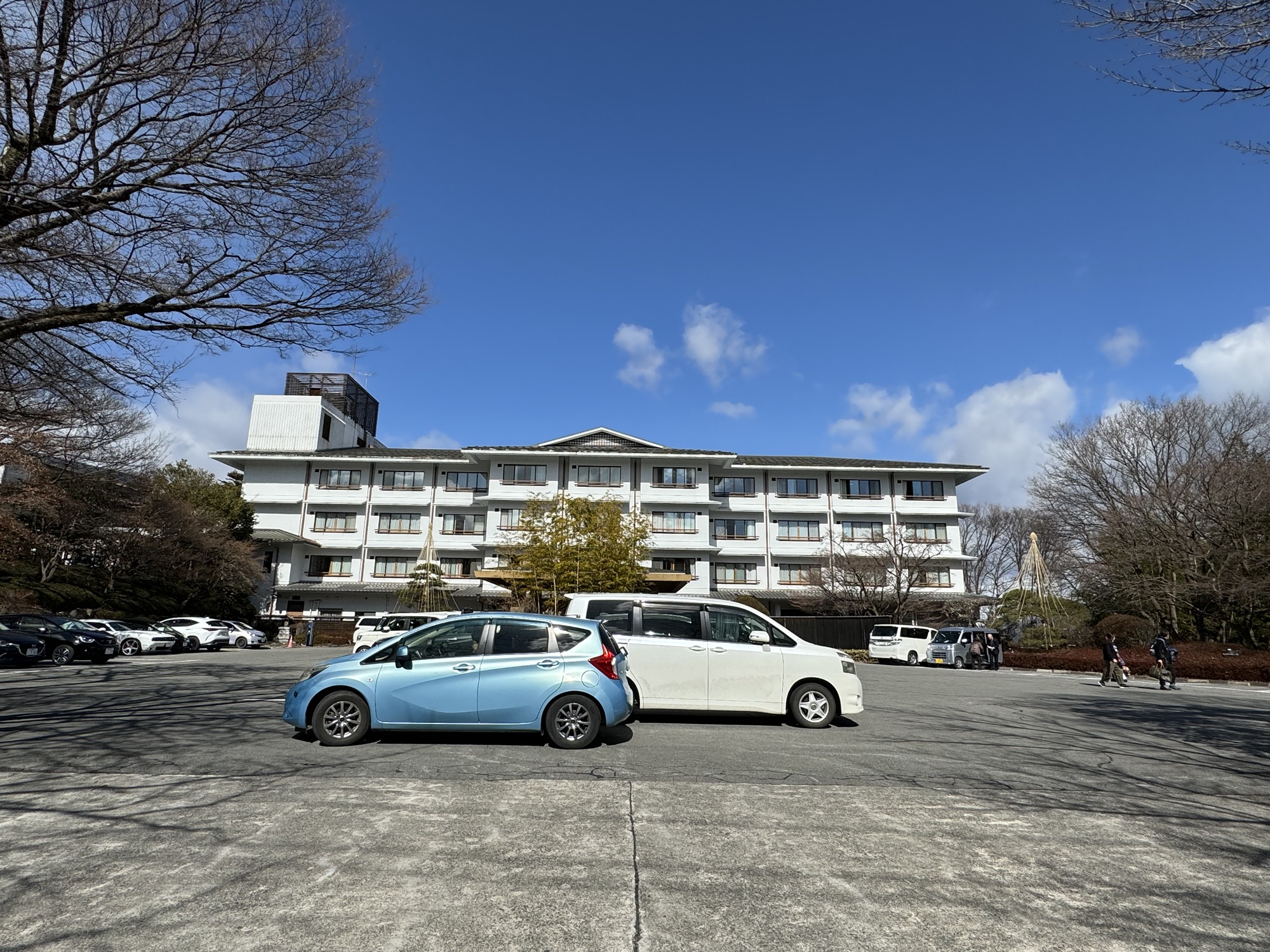
I drove this time, and when I arrived at the 3 p.m. check-in time on Saturday, the parking lot was already packed! As you’d expect from a popular Ikaho inn, everyone gets there early.
The parking lot in front of the inn fills up quickly, so you need to be careful.
Once it’s full you have to park a bit farther away, so considering the hassle of getting around, it may be smart to arrive early and park first.
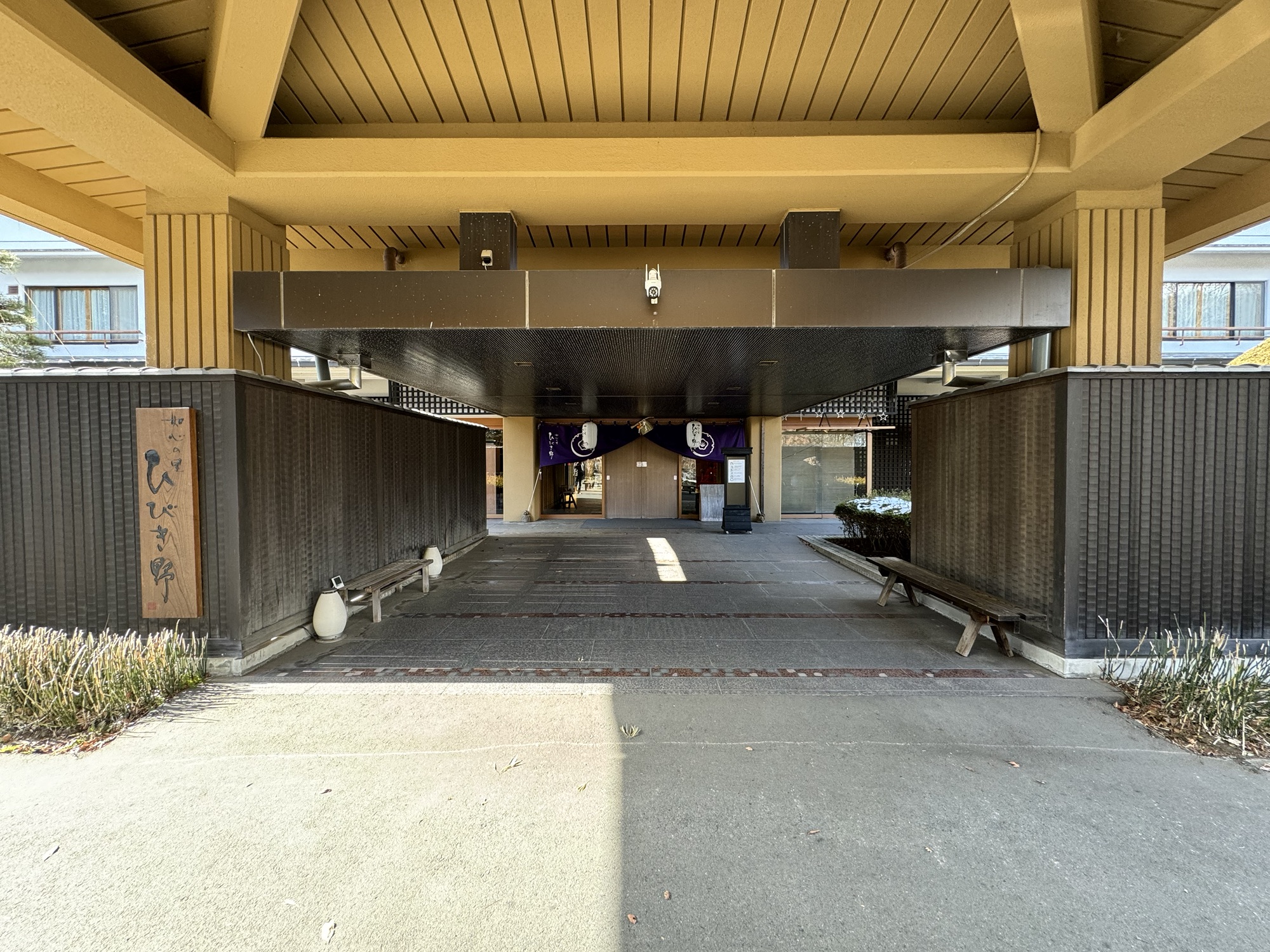
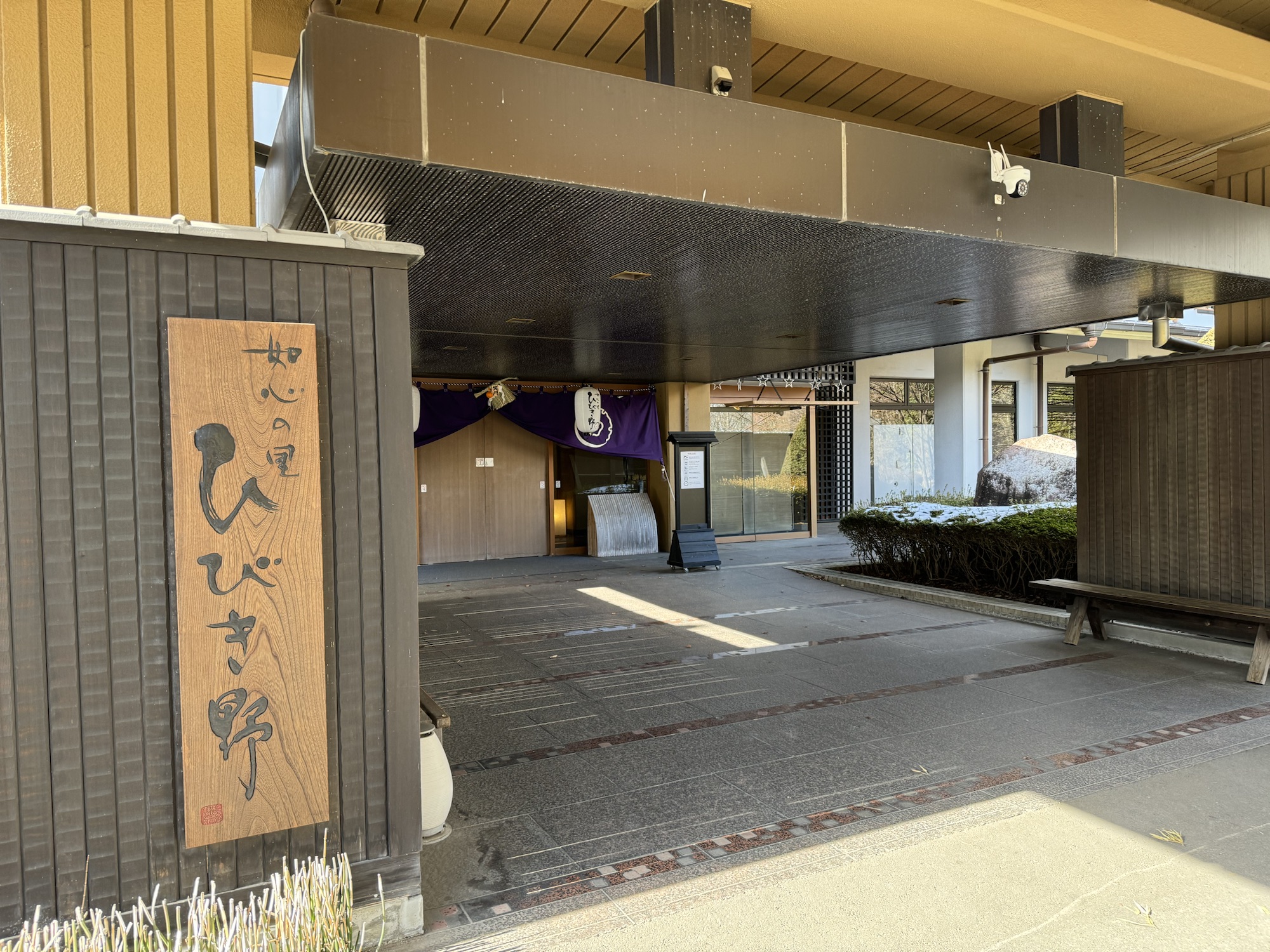
The driveway in front of the entrance has a Japanese feel that suits Ikaho Onsen and is calming.
With the “Japanese” charm and quiet air drifting from the entrance, even before check-in I was convinced “Ah, this is definitely a winner of an inn.”
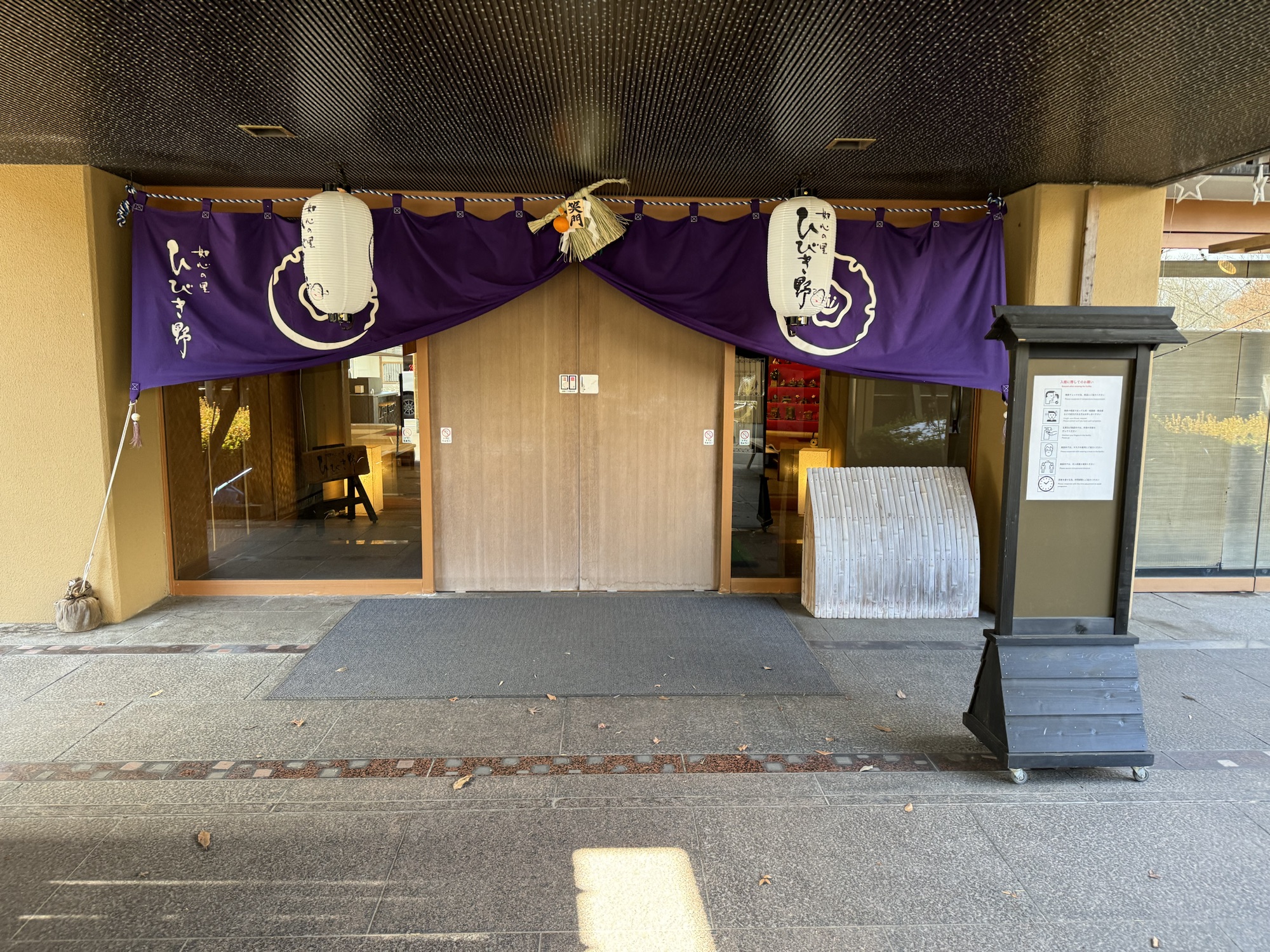
What jumped out at me at the main entrance were the atmospheric hot spring noren curtain and the striking lanterns.
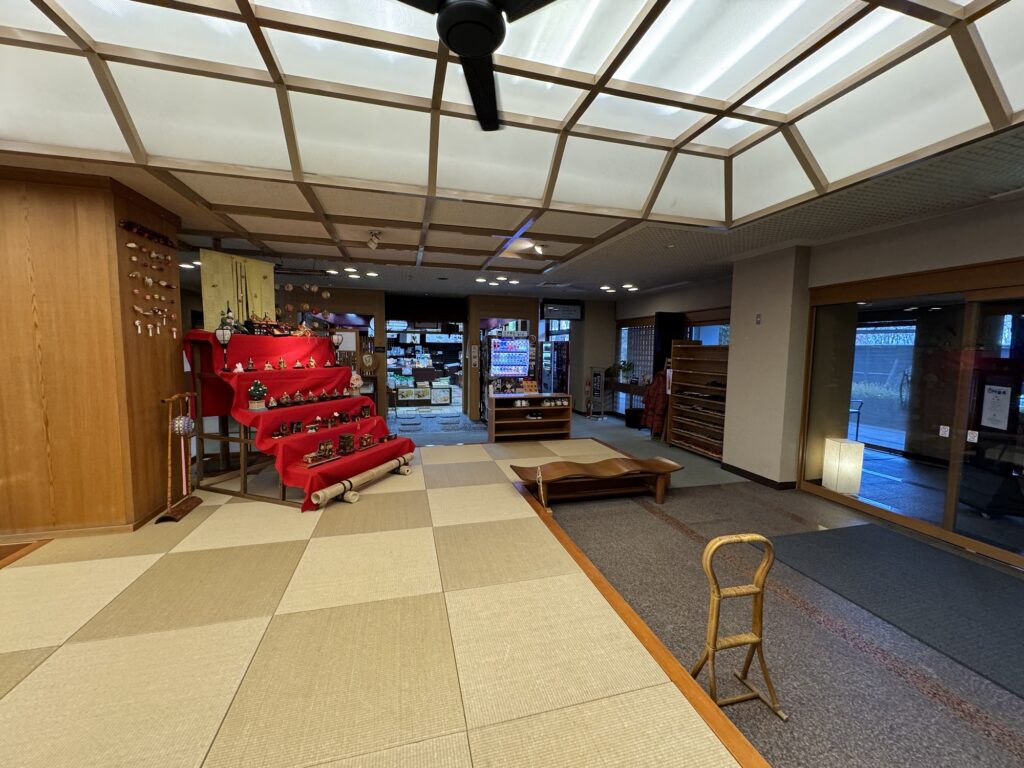
The style is to take off your footwear at the entrance and change into the hotel slippers.
Lately more hotels allow shoes inside, but taking off your shoes at the entrance still flips a switch: “Ah, I’ve come to a hot spring.”
That feeling when your feet suddenly feel light and you’re wrapped in an at-home sense of openness.
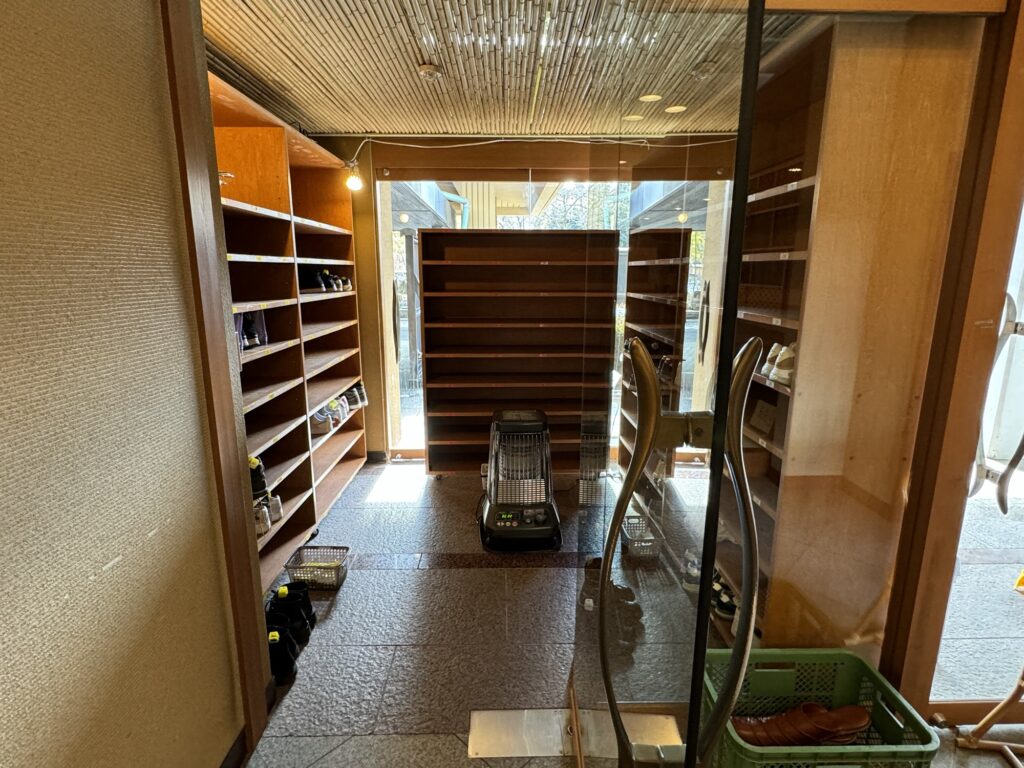
It happened to be the check-in rush, so staff were waiting at the entrance.
Here you don’t put your shoes in the shoe cabinet yourself; the system is that footwear is checked in together by group.
In exchange for the shoes, I was handed a nostalgic “yellow number tag.”
Check-in
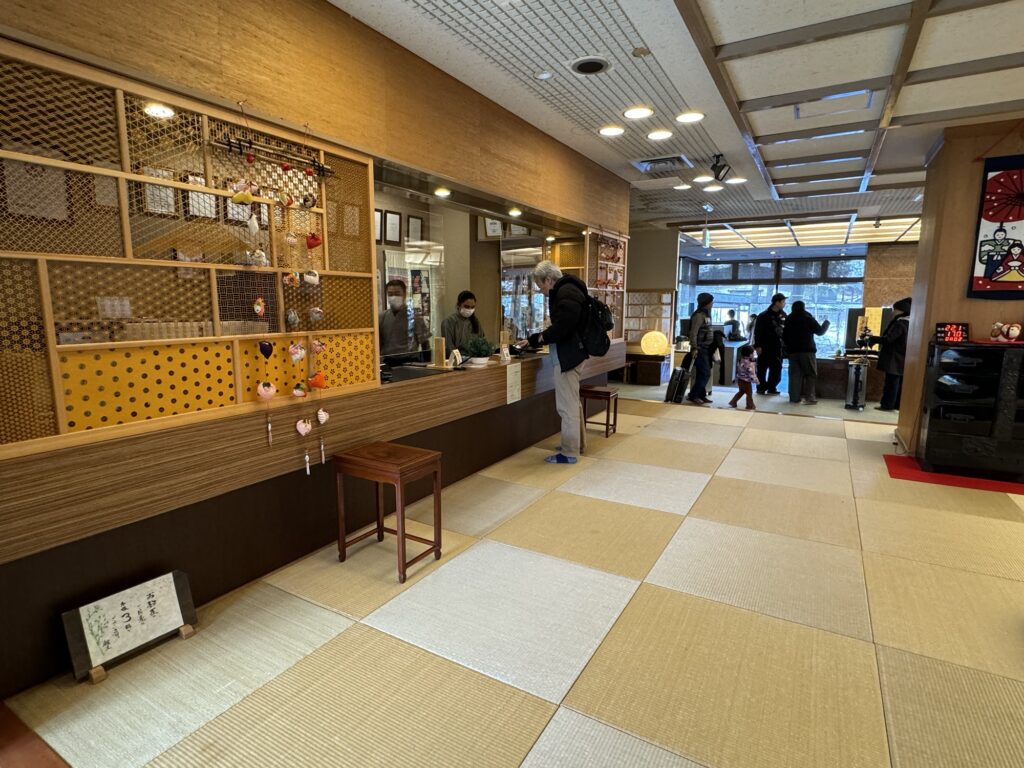
The check-in counter is on the left, right after you enter the main entrance.
You can move around the whole check-in area in bare feet (socks). You can feel the texture of the tatami directly, and it’s surprisingly pleasant.
On the other hand, along the corridors inside leading to the guest rooms, the rule is to move around wearing the hotel slippers you just received.
After a full explanation of the facilities from the staff, the check-in procedure was completed smoothly.
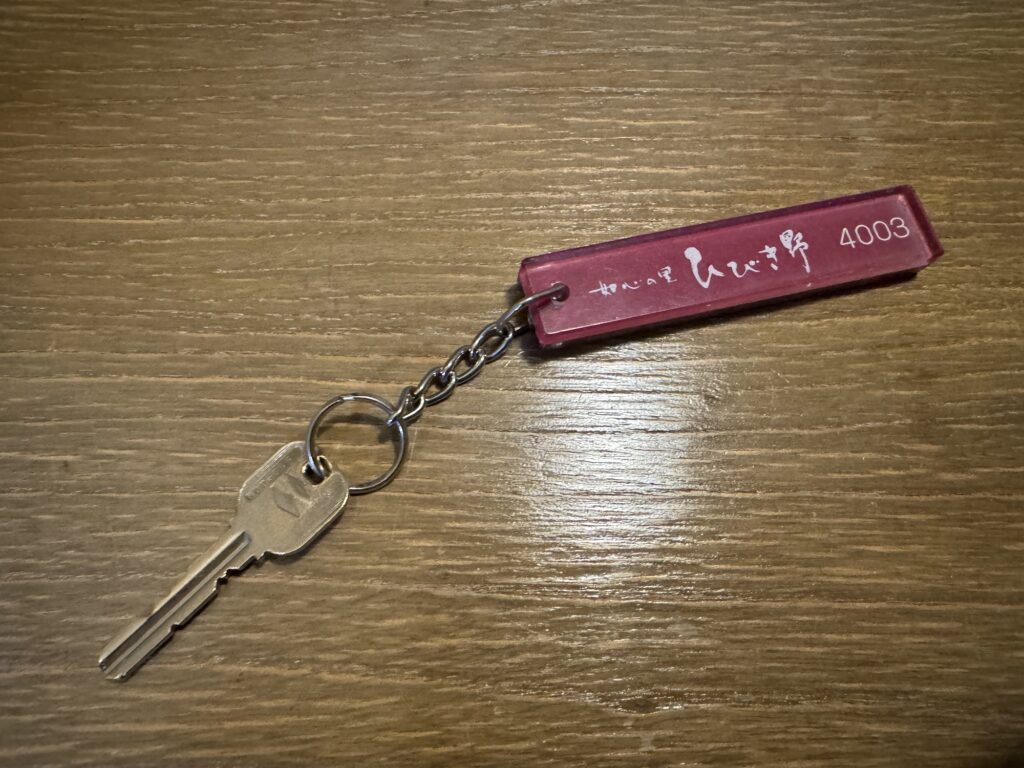
Recently even hot spring inns are introducing contactless IC card room keys, but Hibikino uses “old-fashioned physical keys.”
The feel of it in your hand, and the click you feel when turning the key.
It has a retro charm of its own, and I personally like it quite a lot.
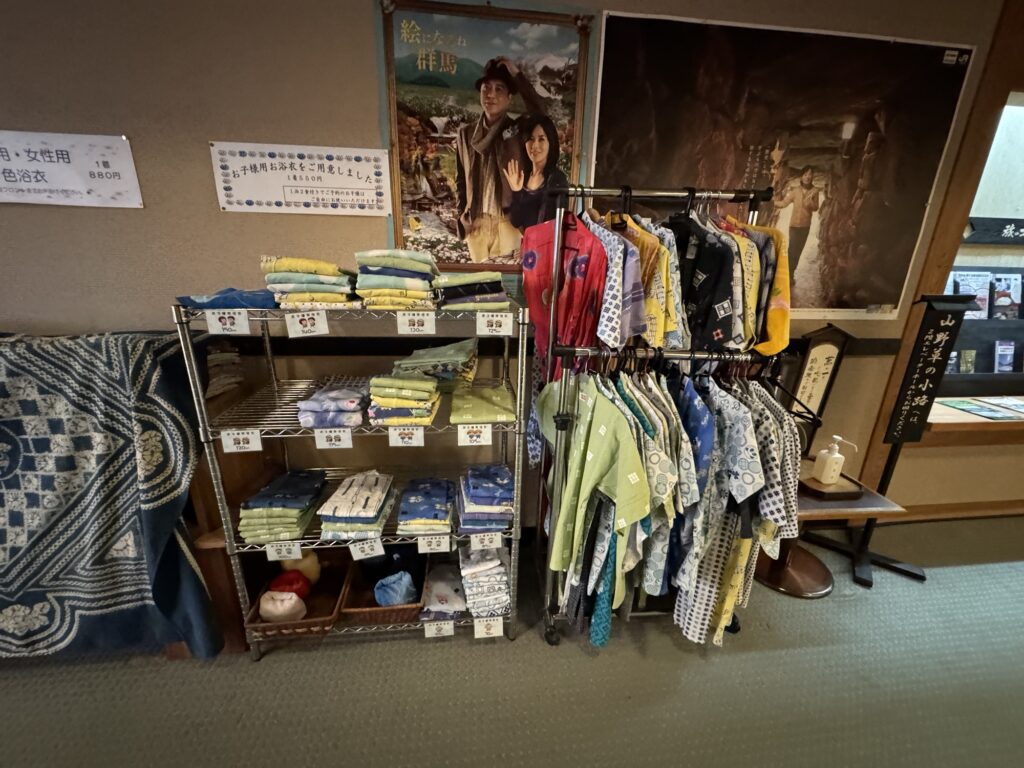
Right next to the front desk on the right is a yukata corner.
The colorful “iro yukata” cost 880 yen each, which felt a bit pricey, but of course you can use regular yukata for free.
What surprised me were the children’s yukata.
There’s quite a wide variety, and you can choose the pattern you like. With this many options, I bet kids would enjoy picking out one that’s all their own.
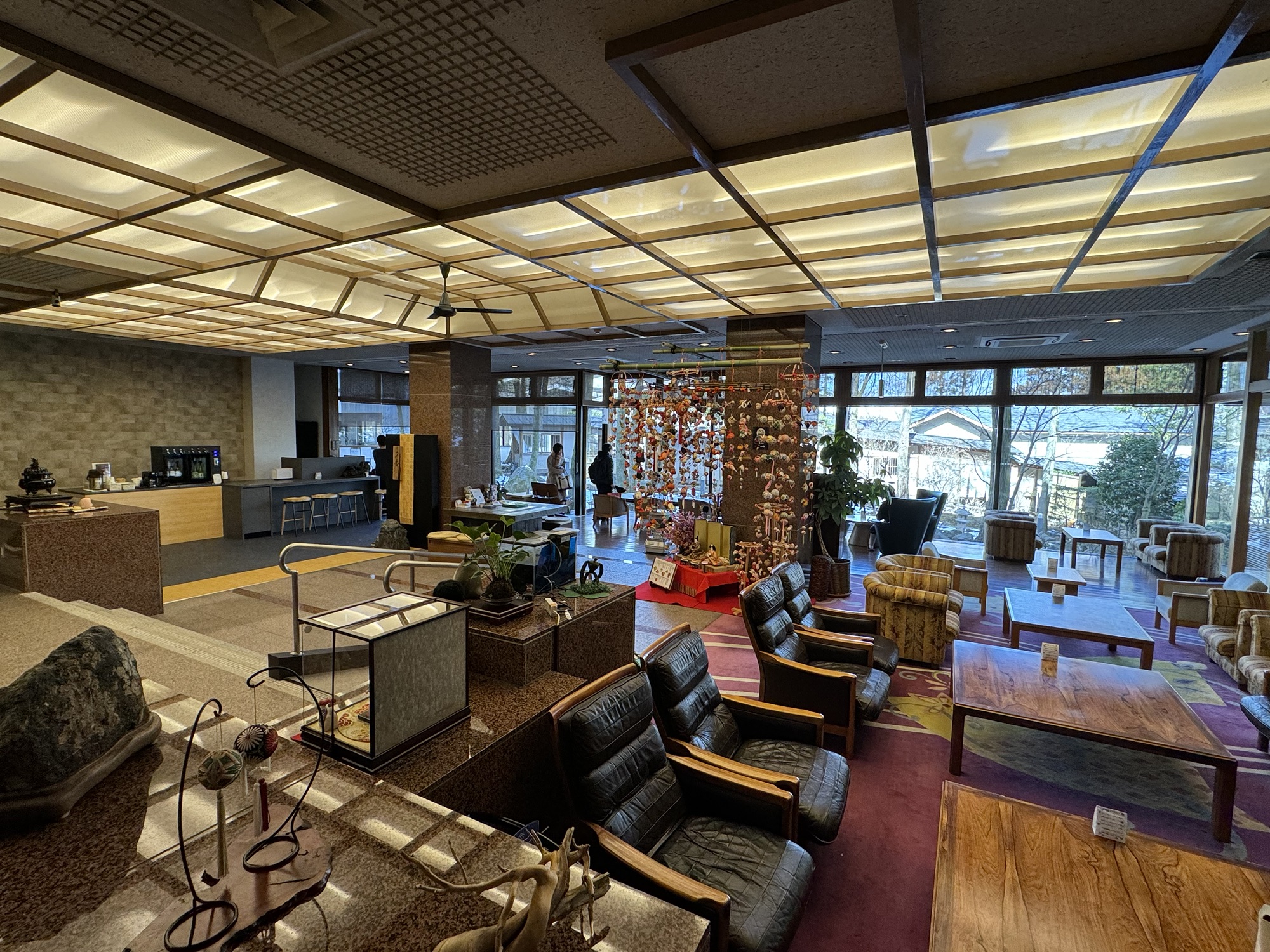
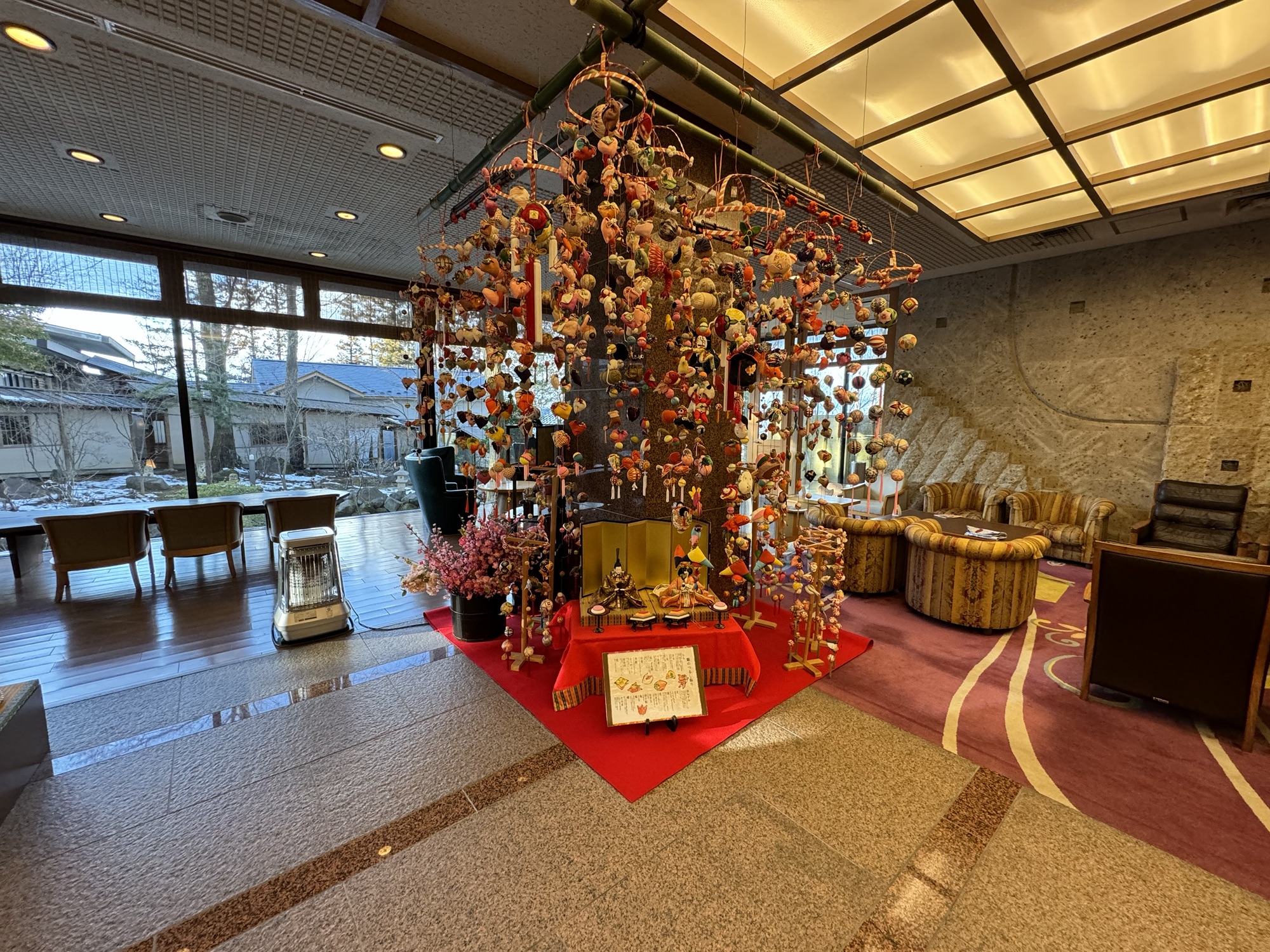
If you go all the way to the end of the main entrance, an airy lounge opens up in front of you all at once.
Beyond the big windows sits the vast garden they’re proud of, so even from the lobby you have the natural scenery all to yourself, a luxurious design!
Spring cherry blossoms, deep summer green, autumn foliage, and winter snowscapes…
Just gazing at the garden, which changes its look with the seasons, makes the fatigue of travel fade away.
Taking a breather here after check-in is truly a healing moment.
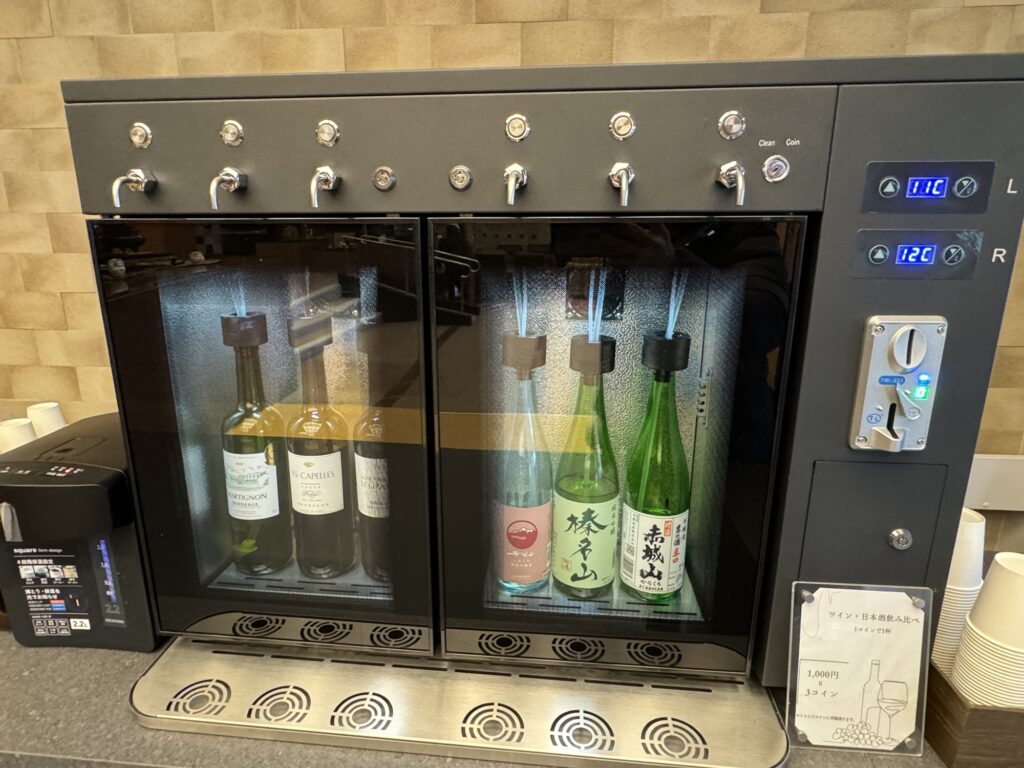
Right near the lounge I found a wine and sake tasting corner that’s irresistible for drinkers.
It works by exchanging 1,000 yen for 3 coins, and you choose your favorite three from the servers to compare.
What I’d definitely have you try here is the Gunma local sake “Harunasan.”
The fresh-stored junmai ginjo in particular is astonishingly light to drink and goes down easily.
Since it’s a sake from Gunma Prefecture, if you like it, it’s also an option for a souvenir or gift.

 ポチップ
ポチップ
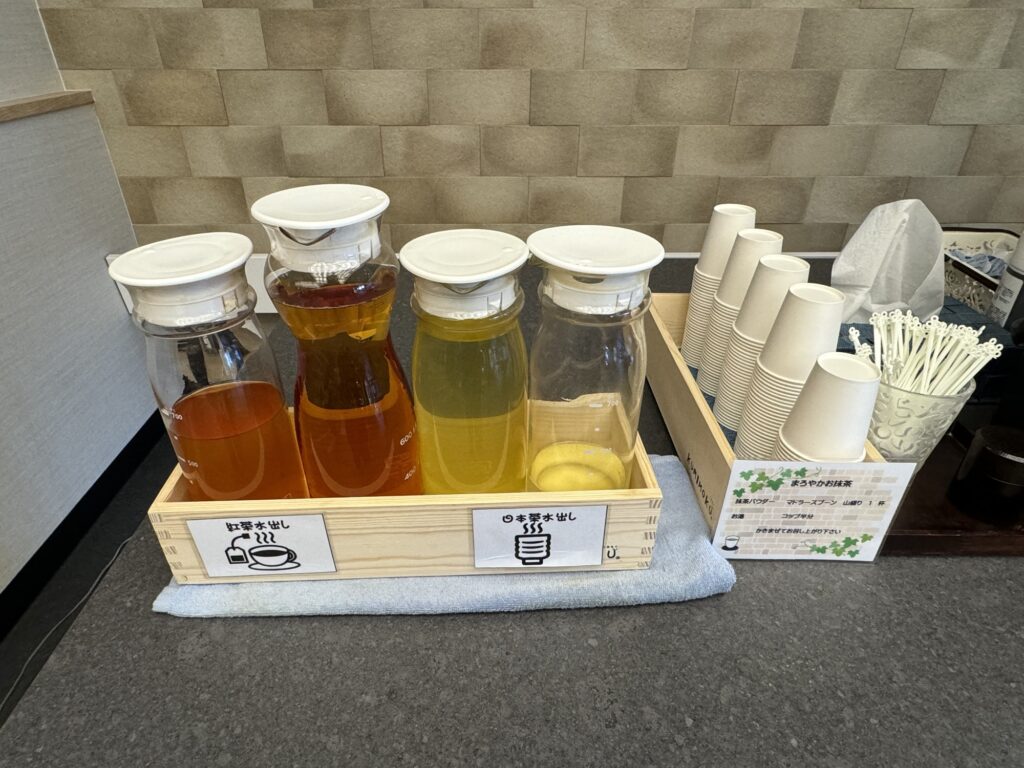
Even if you can’t drink alcohol, there’s no need to be disappointed.
Right next to it, there’s also a cold-brew drink service of black tea and Japanese tea.
The clear sweetness and aroma, free of any harshness thanks to cold brewing, soak into your body.
For a body flushed after a bath or after check-in, ice-cold Japanese tea is the best treat.
Guest Room
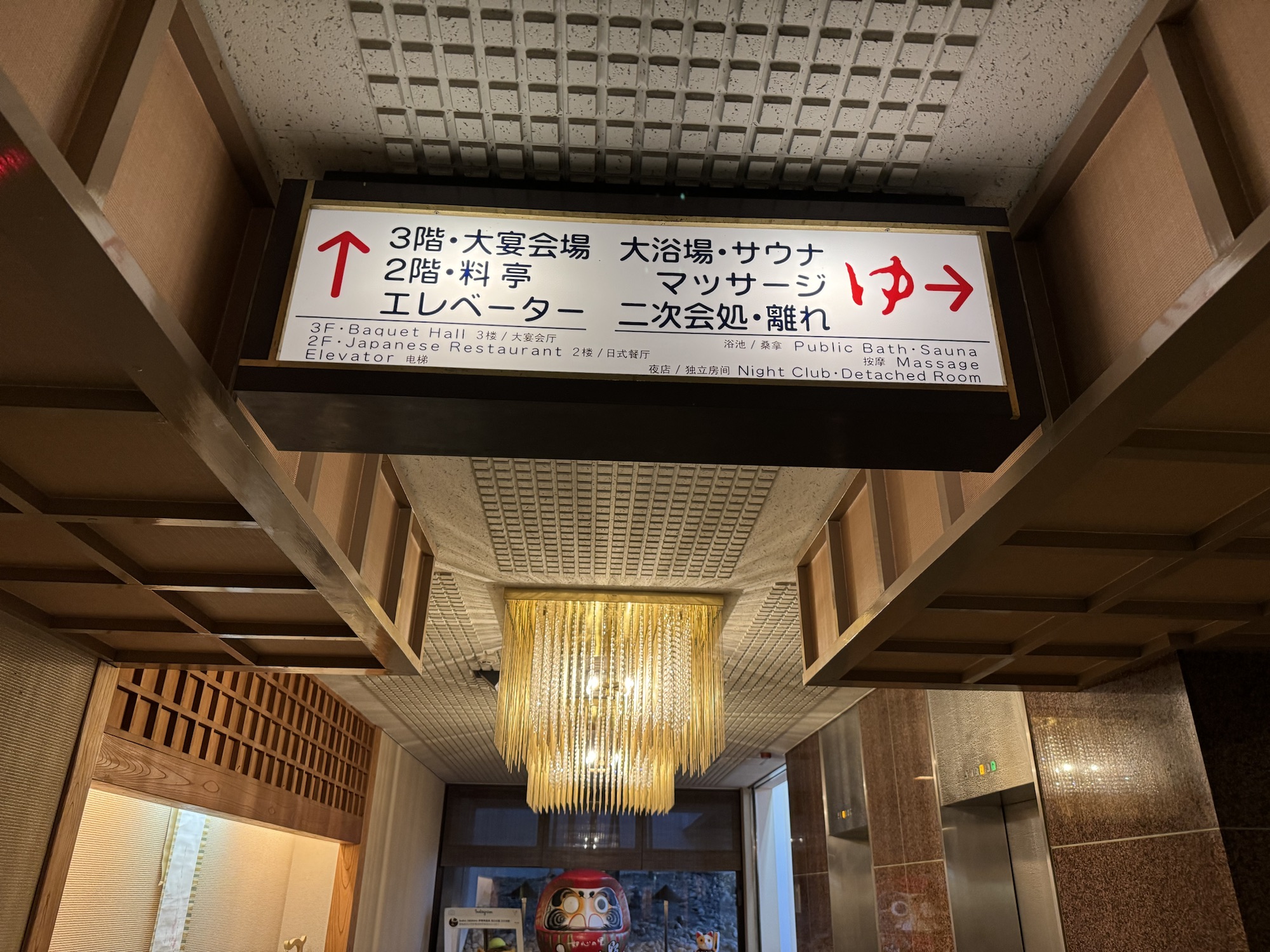
After relaxing in the lounge while looking at the garden, it’s finally time for the guest room.
On the way, what caught my eye was an old-fashioned “in-house signboard.”
Not digital signage or foreign-language plates like at recent hotels, but brush-lettered guidance that conveys the warmth of wood.
This too creates the charm of a Japanese inn to the fullest.
Cutting-edge facilities are nice, but when I touch this kind of good old Japanese inn feel, I somehow feel strangely calm.
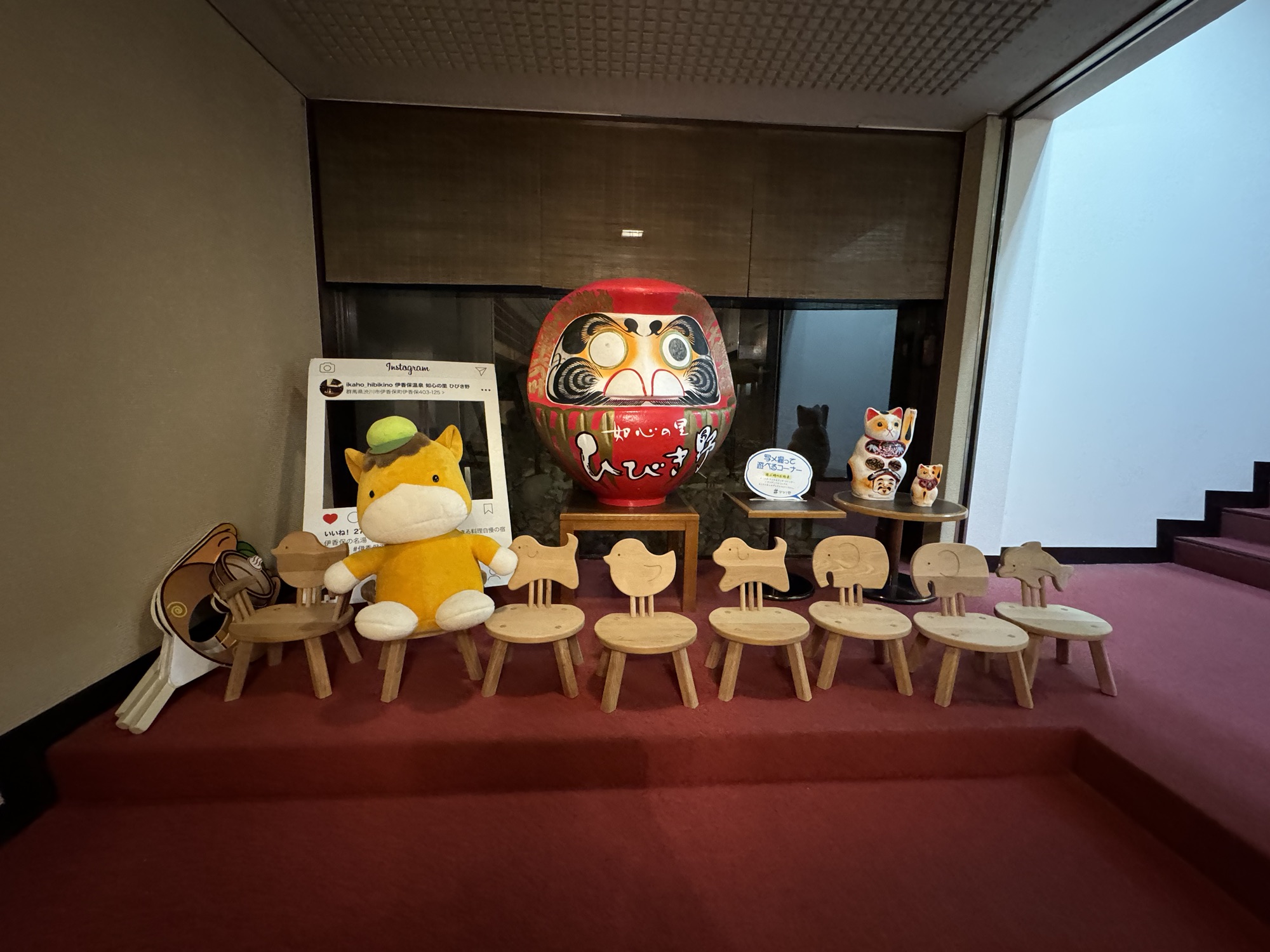
Going further along the corridor, I came across a spot with a big “daruma” doll, so typical of Ikaho.
It had such a presence that I stopped and took a commemorative photo.
With an obvious photo spot like this, the memories of the trip are preserved in a tangible form, which is nice.
In front, I found a whole row of children’s chairs.
On a family trip with small children, just sensing this kind of “kids welcome” atmosphere makes a huge difference in peace of mind.
It reminded me again that this is an inn where the whole family can relax.
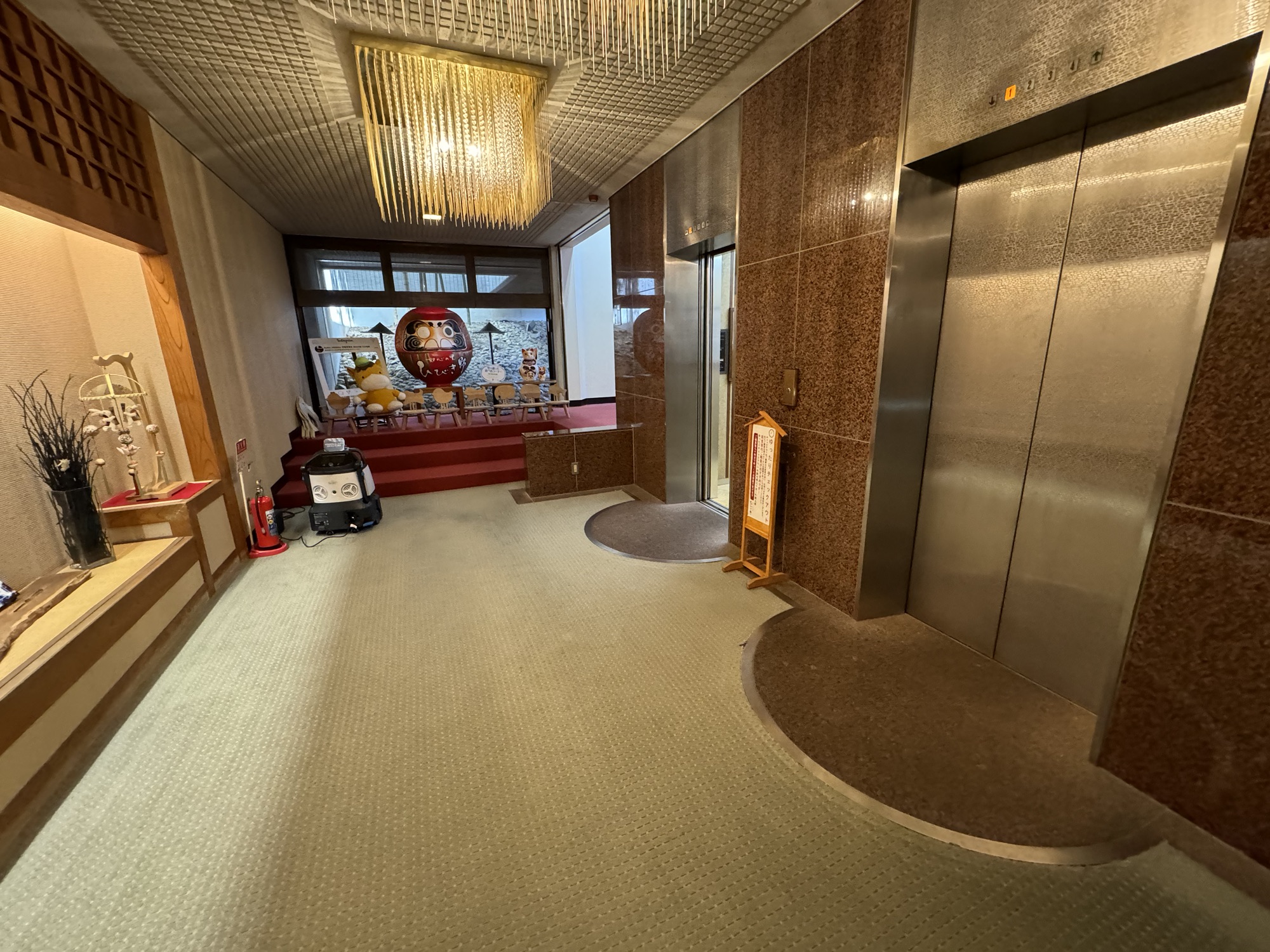
I took the elevator here to move to the guest room floor.
If the elevator is crowded right after check-in, it seems you can also use the stairs at the back.
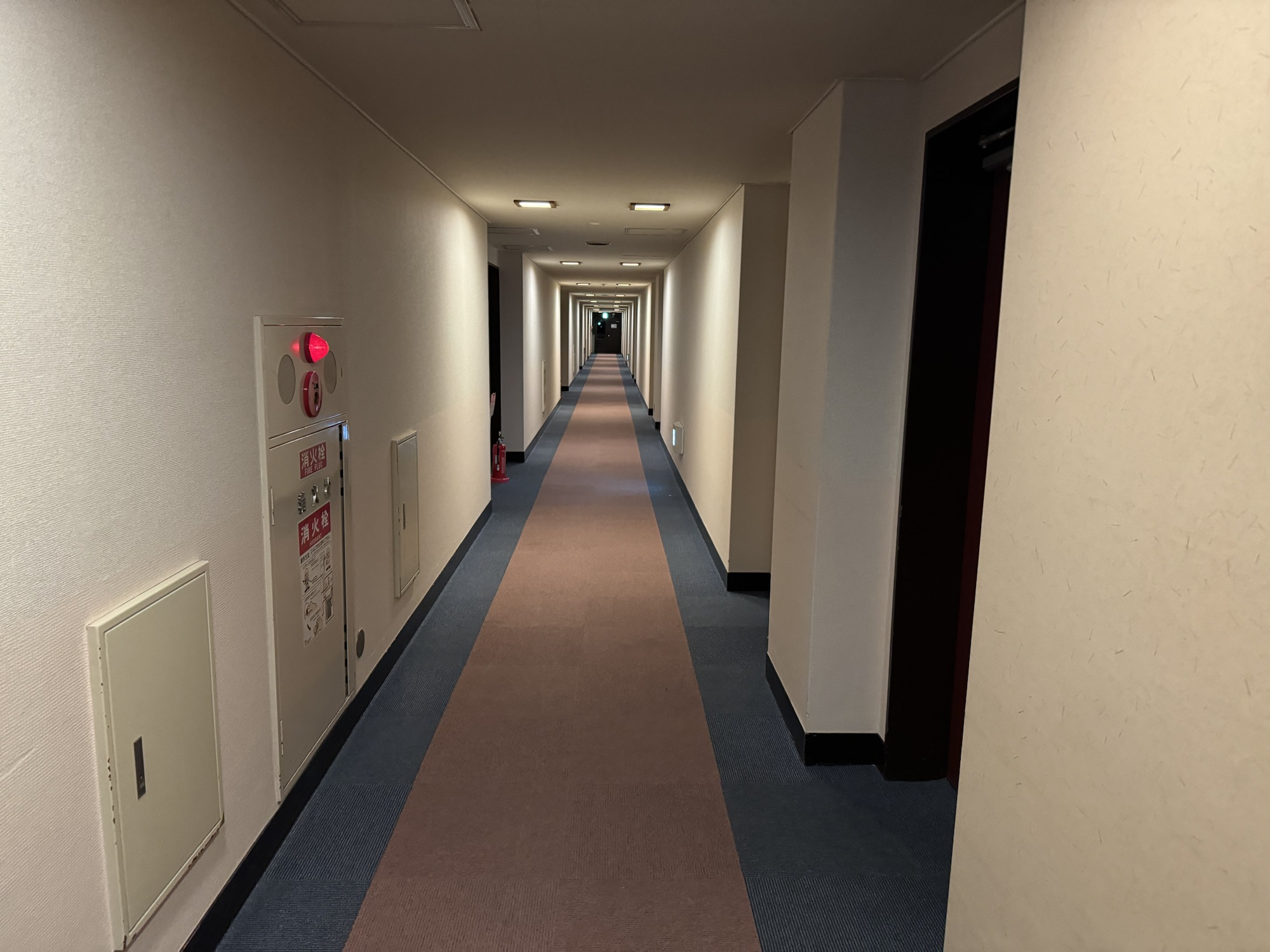
Stepping off the elevator into the corridor, the Japanese atmosphere so far shifts a bit, and you can feel a somewhat hotel-like Western touch.
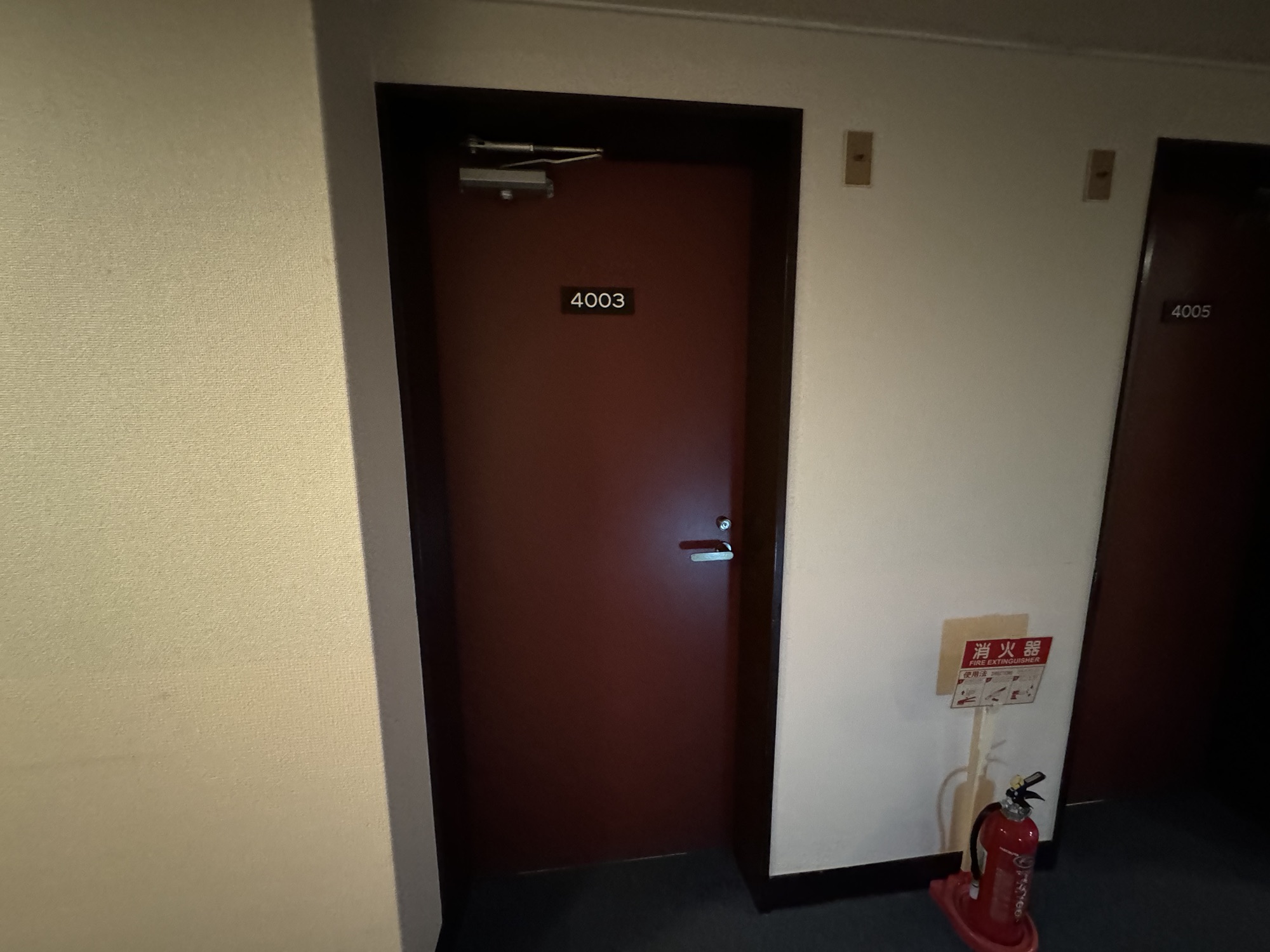
At last, I arrived at today’s room!
The room entrance is an old-style door opened with a clunk using the “physical key” I received earlier, with a nostalgic feel.
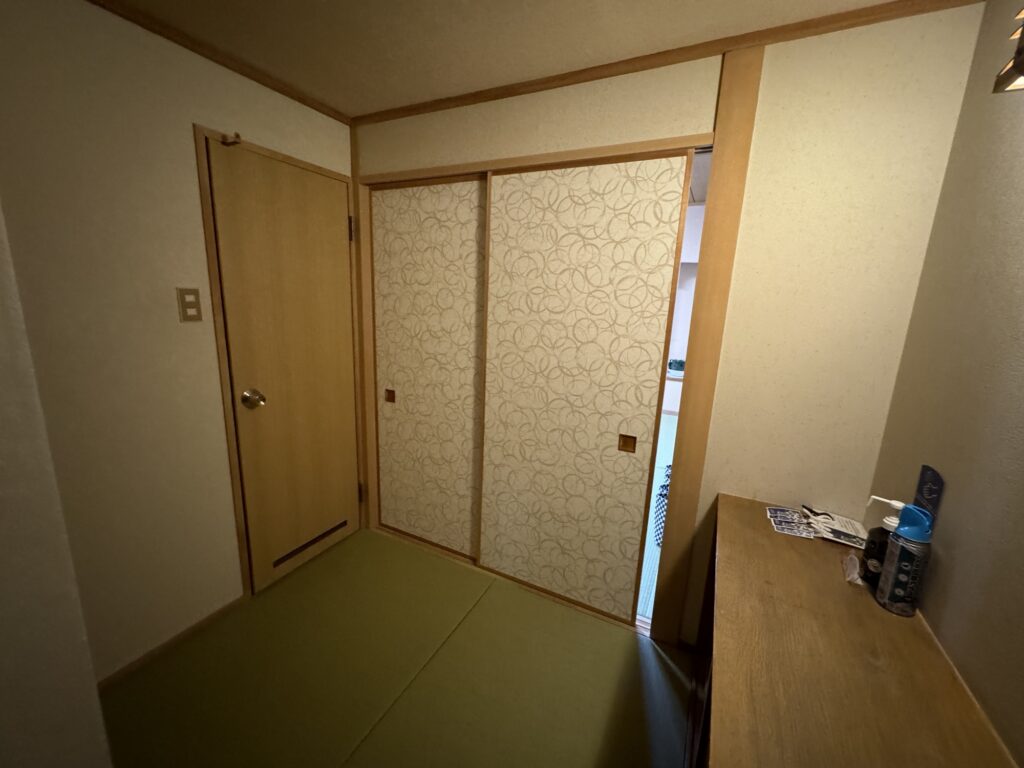
The moment I opened the door, what surprised me first was the spacious tatami-floored entrance hall of more than one tatami mat!
At a business hotel or an ordinary hotel, the entrance is naturally tile or wooden flooring.
But being able to touch tatami from the very first step is truly the “relaxation of a hot spring inn.”
And when you slide open the magnificent fusuma sliding door in front, the main Japanese-style room spreads out beyond…
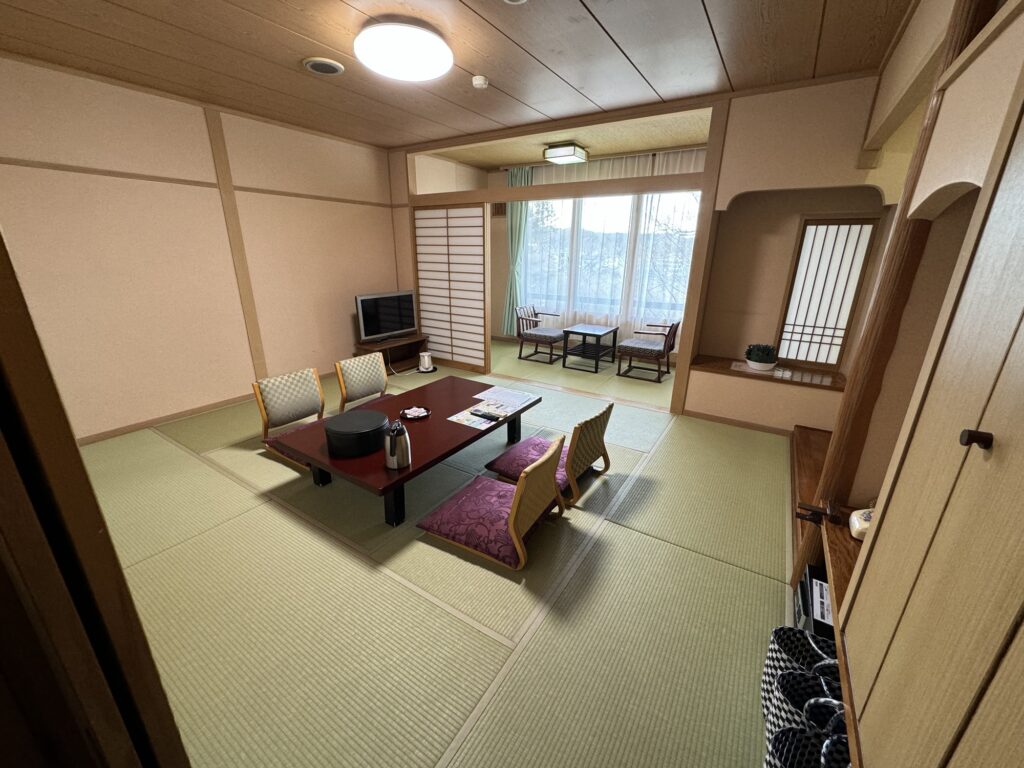
Open the fusuma and an 8-tatami Japanese-style room spreads out.
The scent of tatami drifts softly, truly the Japanese hot spring inn. In the middle are a solid low table and zaisu chairs, and a calming space spreads out.
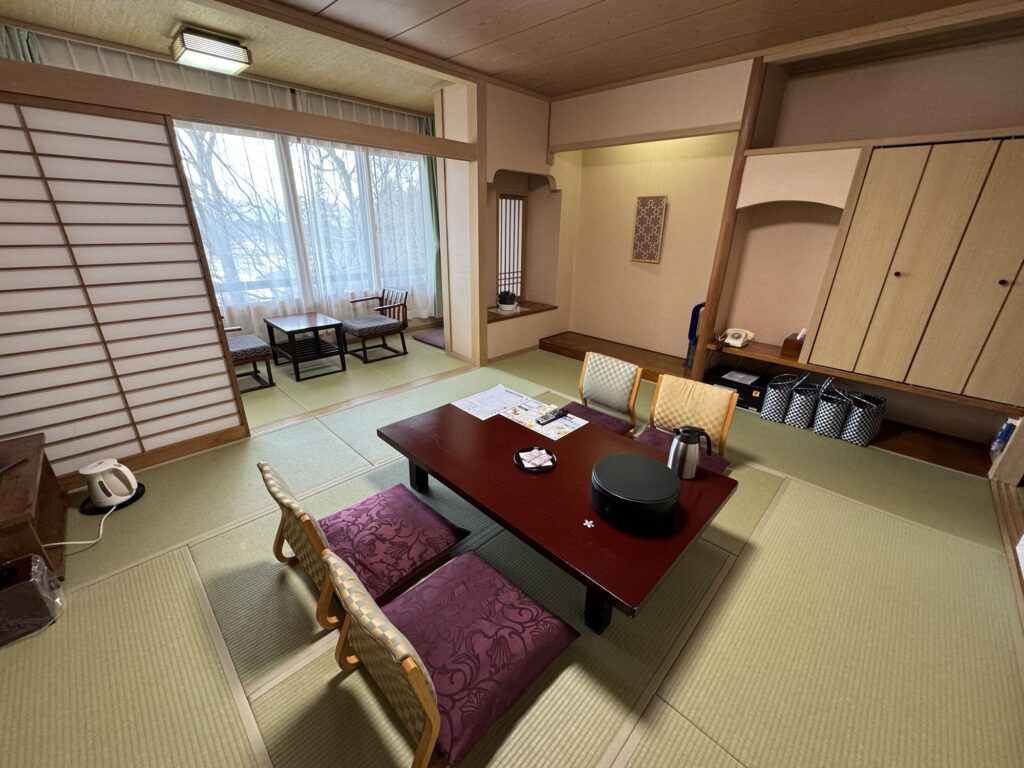
Placed around the low table are thick, wine-red cushions.
This calm color and the firm thickness that gently supports your bottom add a real sense of luxury to the space.
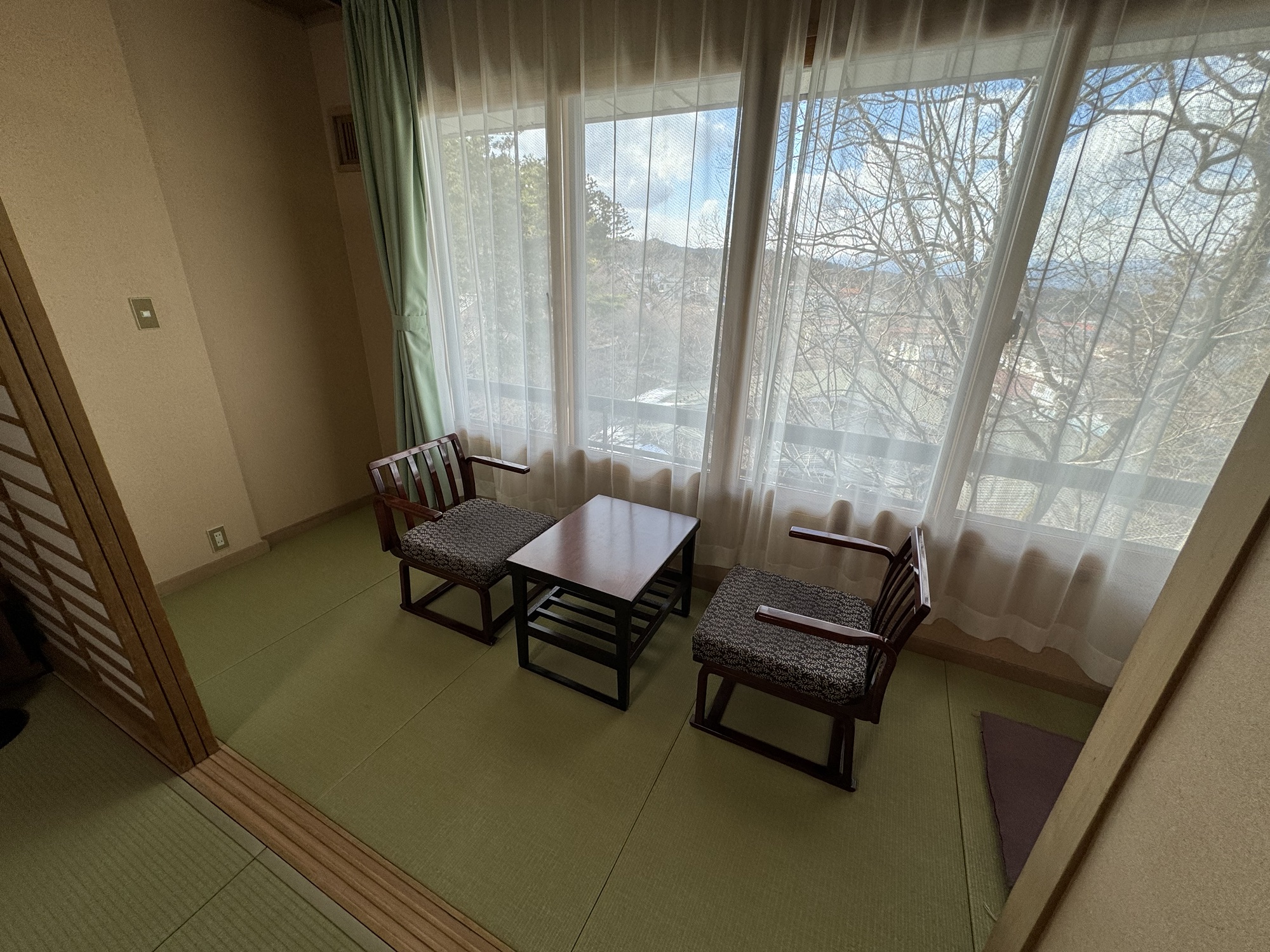
The chairs on the wide veranda are deliberately designed low, so when you sit, your eye level drops and the view outside comes at you more directly.
The table is indeed on the small side, but strangely that actually fits well and never makes it feel cramped.
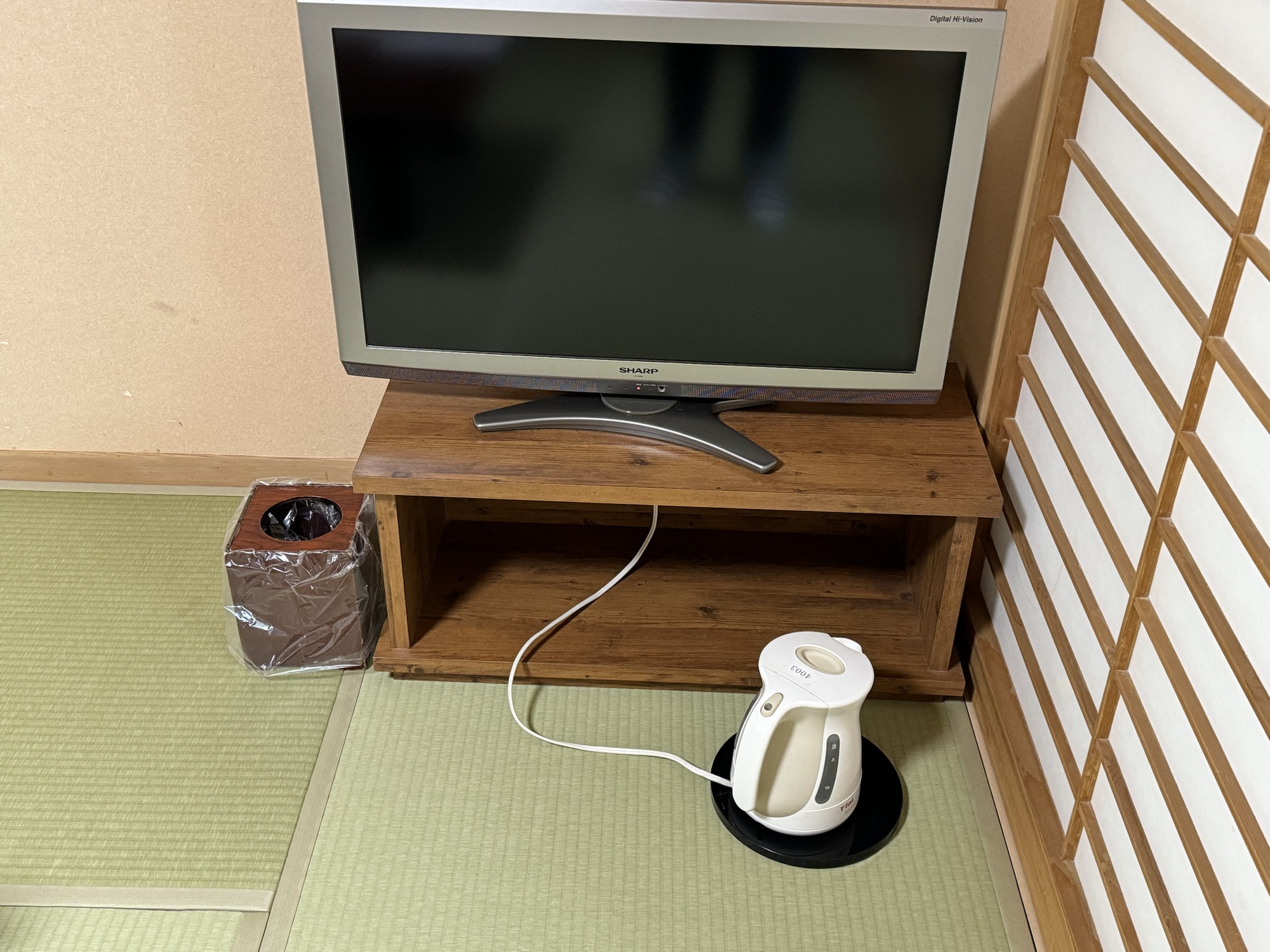
The TV is in the corner, but it’s placed in front of the bed (futon), so it’s the best position for watching while lying down.
However, the size is a bit under 20 inches, quite compact. What bothered me more was the electric kettle right in front of the TV.
Probably because of the outlet situation, it was somehow placed directly on the tatami.
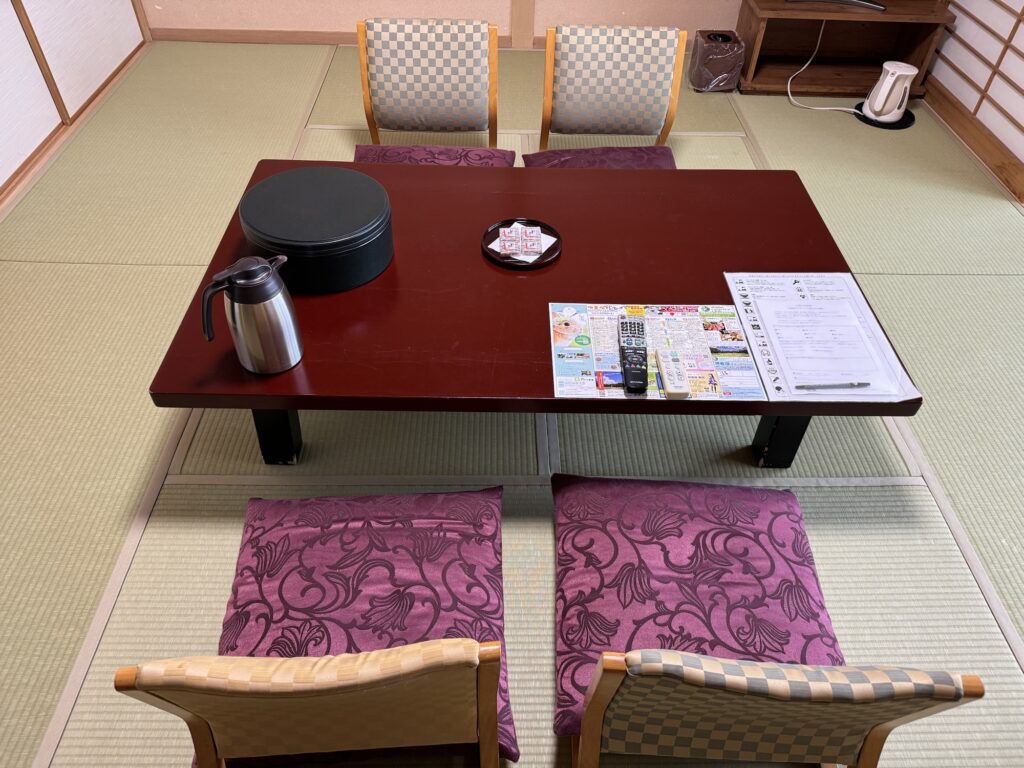
On the low table is everything you need for your stay.
A TV guide, a facility guide, and the “tea pot” and “welcome sweet” that a hot spring inn can’t do without.
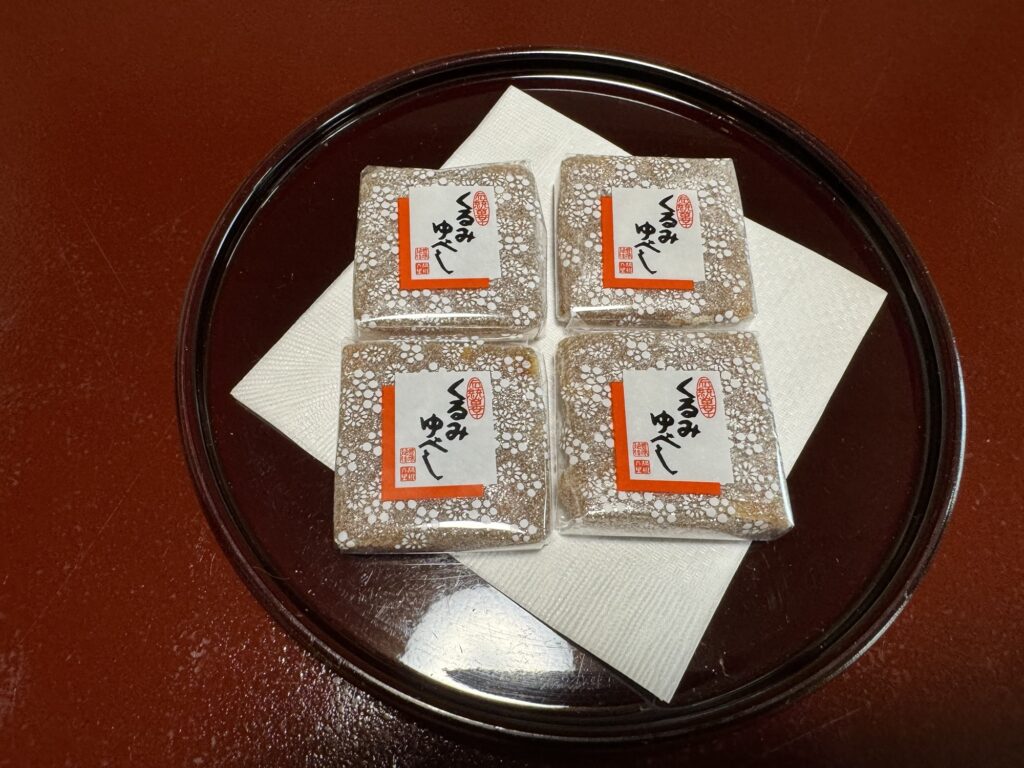
The welcome sweet I look forward to is “walnut yubeshi,” an Ikaho classic.
And it isn’t just any yubeshi; it uses soy sauce from Shoda Shoyu, a long-established maker that’s been around since 1873.
One bite and the mellow, deep richness of the soy sauce spreads softly, matching the fragrant texture of the walnuts perfectly.
It keeps well, so it’s perfect as a souvenir too. It’s nice that if you like it, you can buy it right away at the shop on the 1st floor.
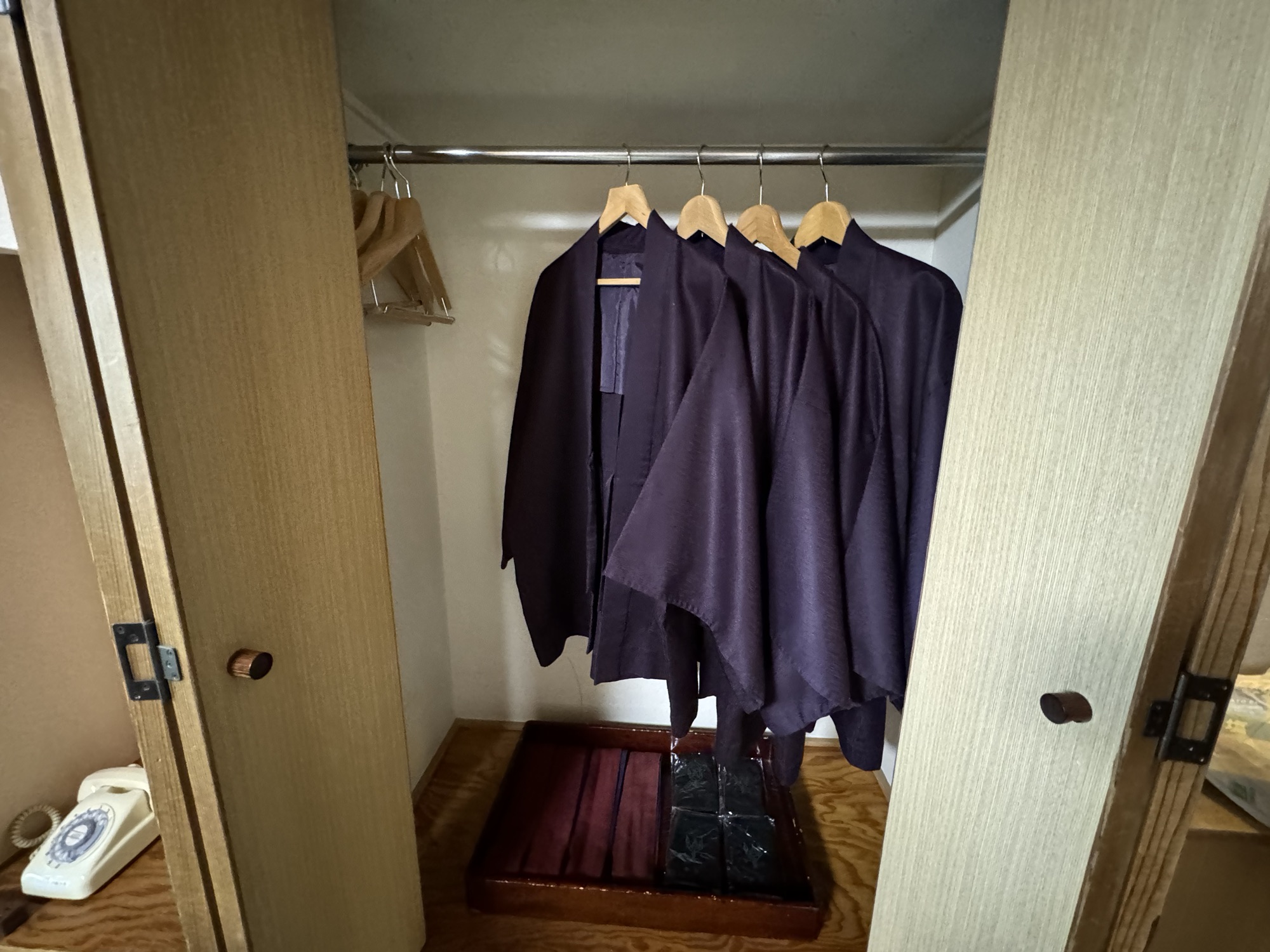
Open the closet and neatly stored inside are haori jackets and bath towel sets for each guest.
The haori are a unisex design, simple ones that anyone can slip on quickly.
What surprised me was the number of hangers!
Enough are provided that even four guests would have more than enough, so there’s no worry about fighting over who uses which hanger.
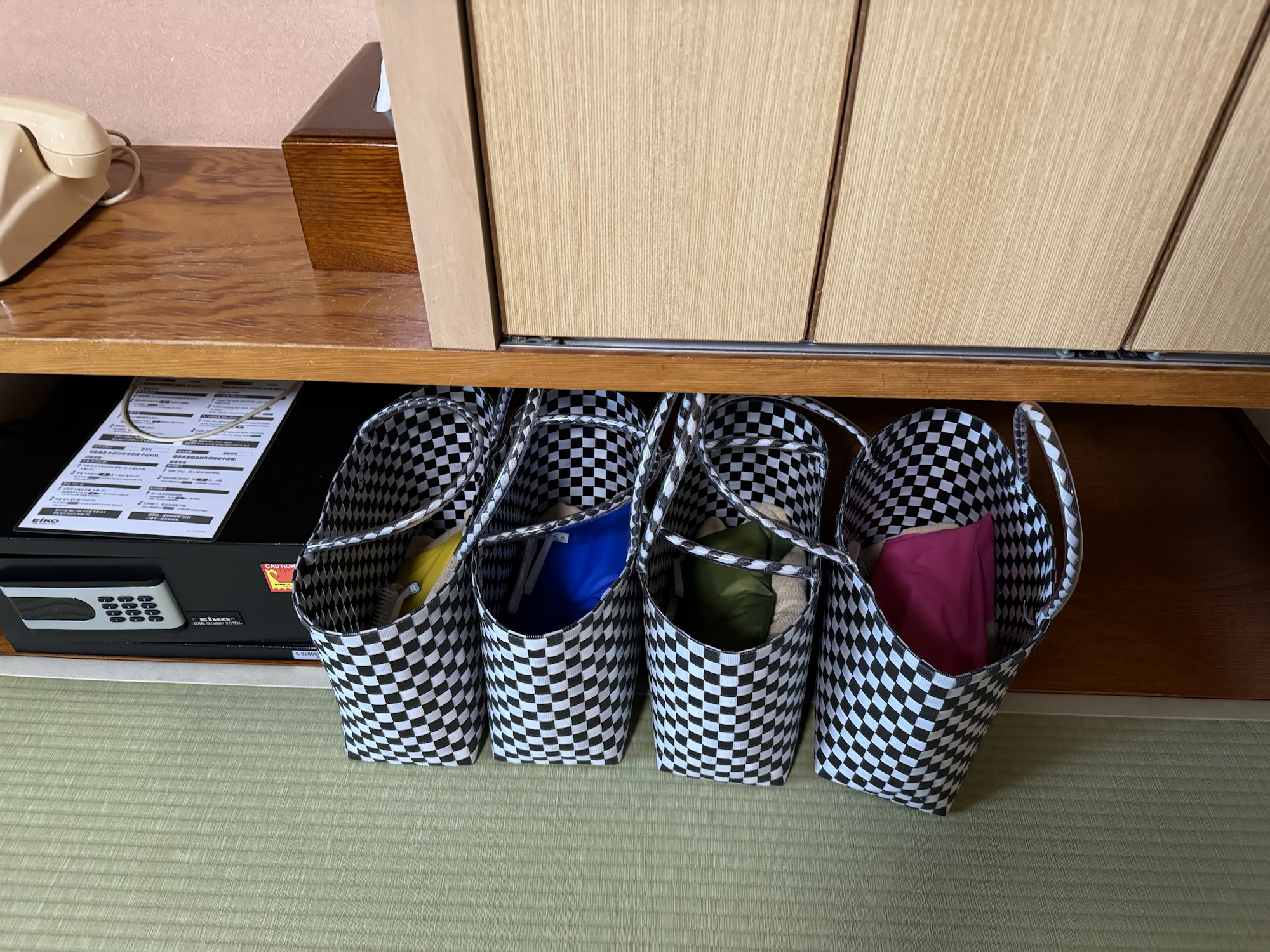
Along with the haori, obi sashes are also prepared in advance in the closet.
But if you think “I’d rather have something easier to move in than a yukata,” you can also choose a samue (work-style loungewear).
However, samue aren’t kept in the room, so the key is to remember to pick them up from the corner near the elevator hall!
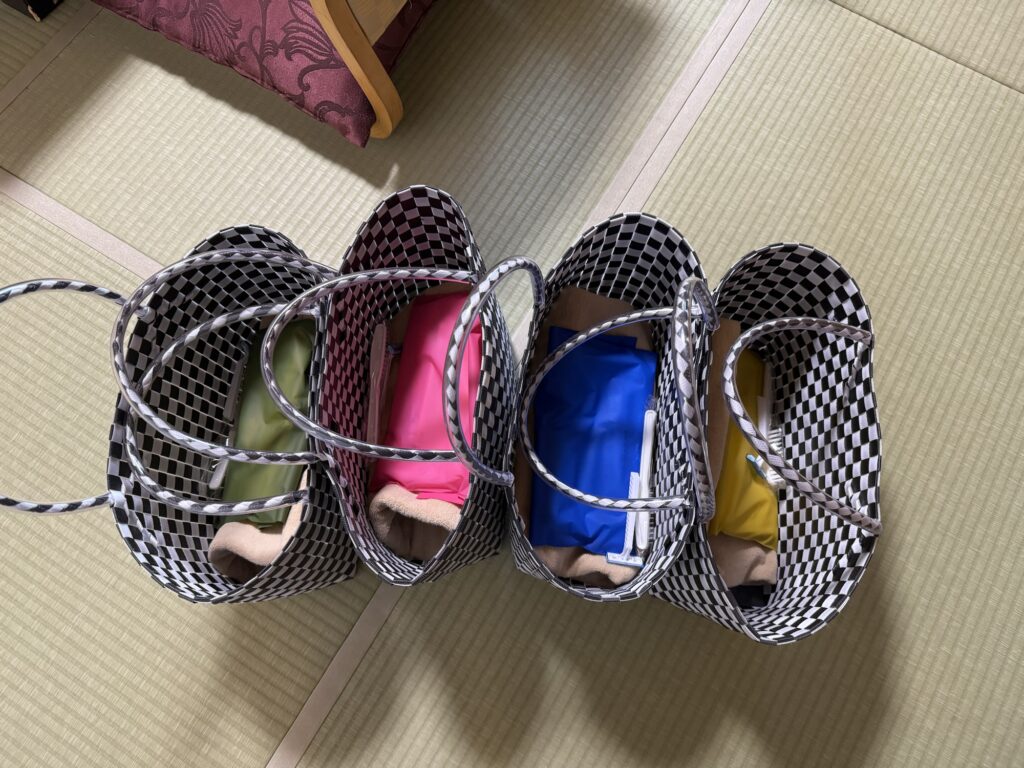
Inside is a set of a colorful drawstring pouch and a colored face towel.
There are several colors, so it’s fun to take time choosing your favorite with family or friends, saying “I’ll take this one!”
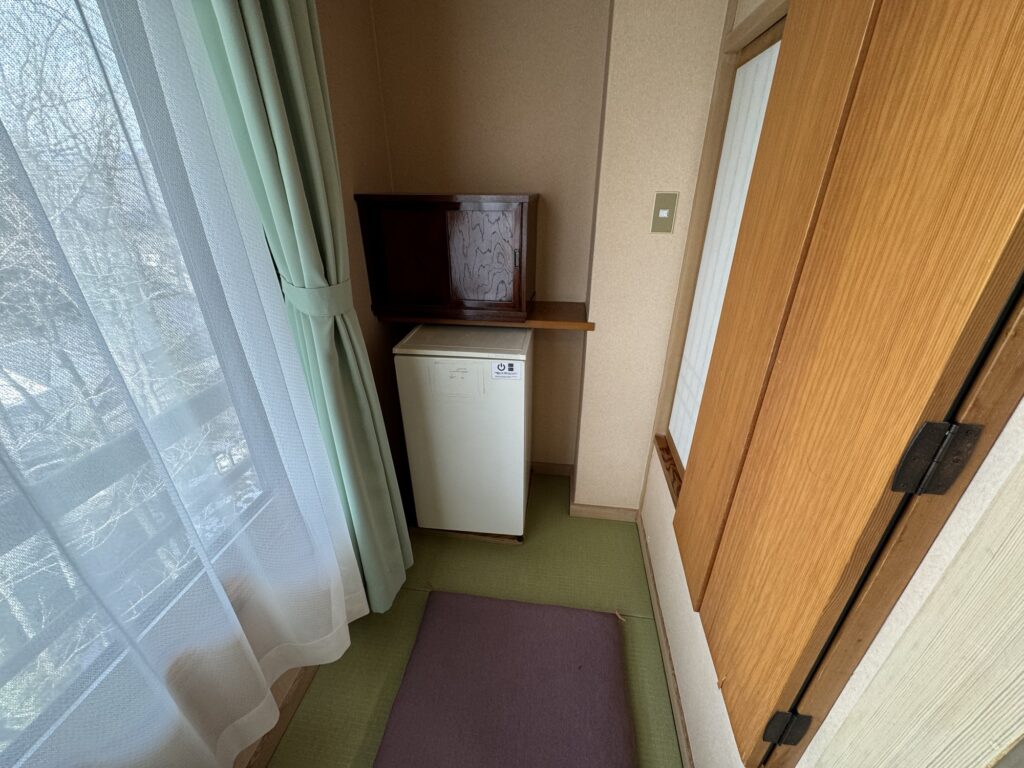
In a corner of the wide veranda there’s also a proper refrigerator.
Open the cupboard above it and there are glasses, so you won’t have trouble drinking drinks you brought in or cold water after a bath.
Next to it is a fine double-door full-length mirror. It seems handy for tidying up your appearance… but perhaps because of its placement, in practice you may find it a little awkward to use.
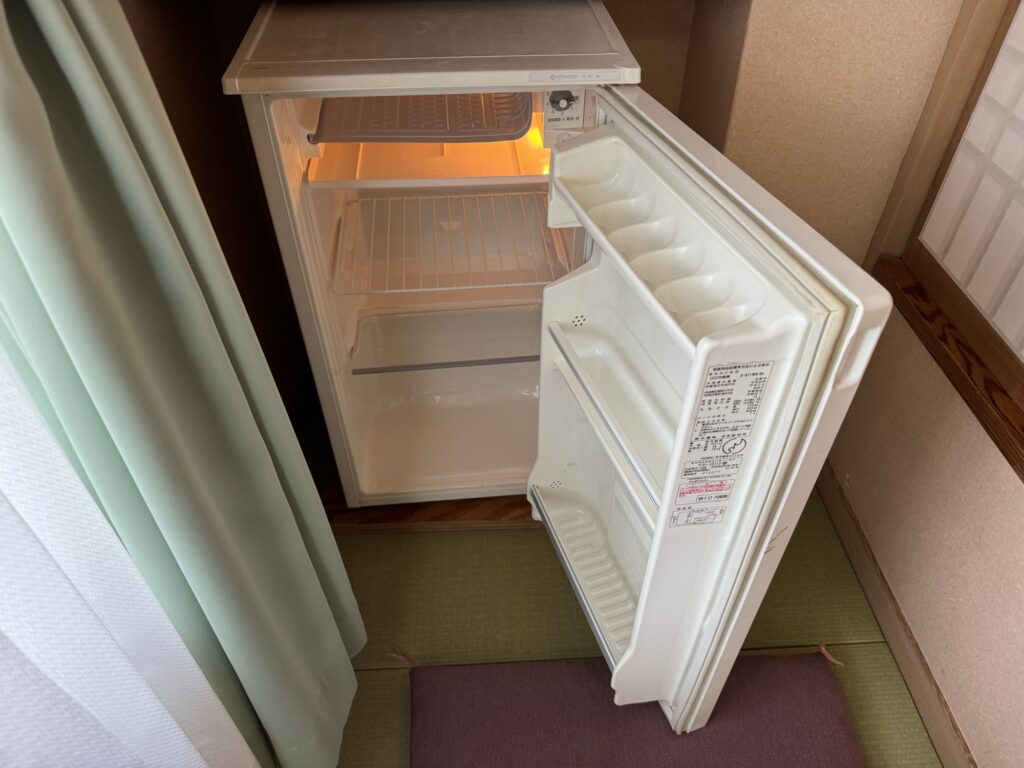
Checking the refrigerator again, it’s surprisingly large and easy to use!
What’s even nicer is that it’s already switched on and the inside is ice-cold from the start.
Bathroom, Toilet, and Washbasin
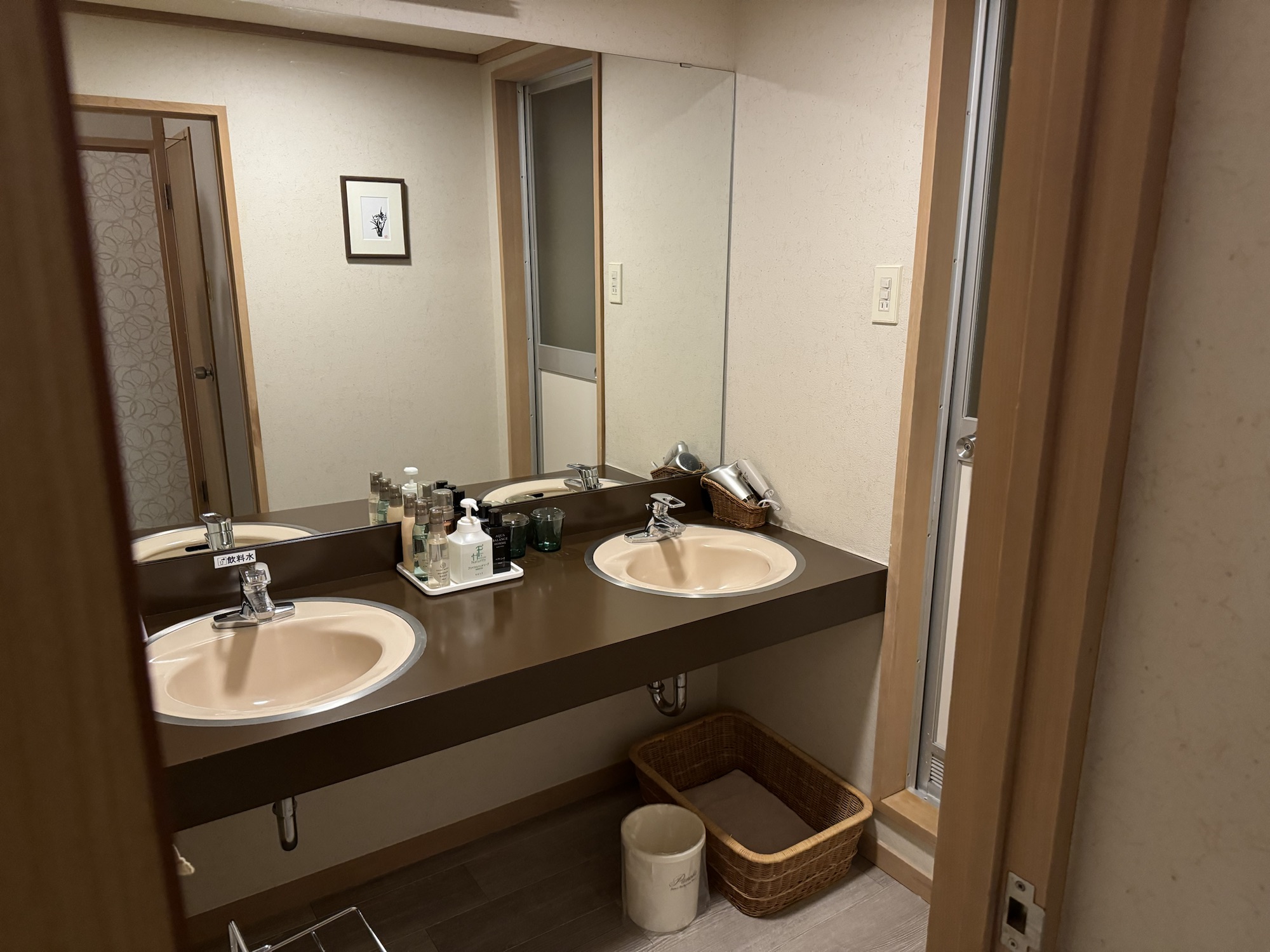
What surprised me when I checked the plumbing area was the space and functionality!
The bathroom, toilet, and washbasin are all separate, so even families and groups can use them without worrying about one another, which is hugely convenient.
In particular, having two washbasins side by side is really appreciated during the busy morning hours.
No one hurries you with “hurry up and switch!”, and you can get ready elegantly in a spacious area.
Just note that no amenities are placed at the washbasin at all.
The style is to bring what you need, such as a toothbrush and razor, in advance from the amenity buffet next to the welcome drink corner that you saw at check-in.
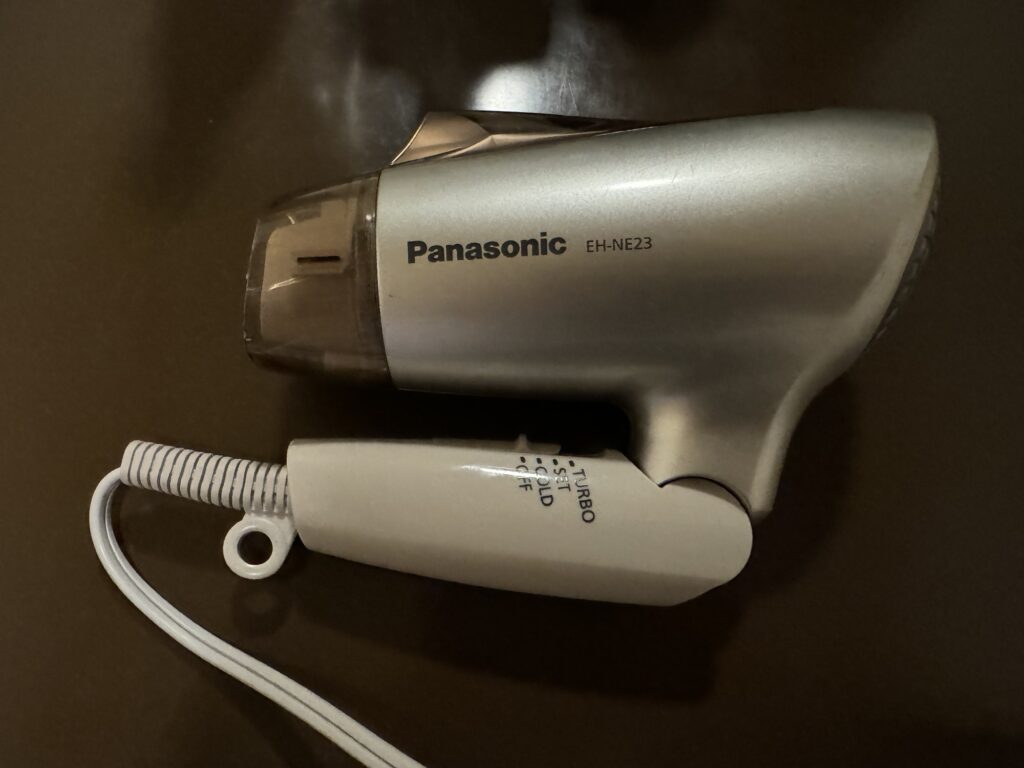
The washbasin is fully equipped with a Panasonic “ionity” series hair dryer.
It’s a model with plenty of negative ions, so it’s nice that your hair dries without getting frizzy after a bath.
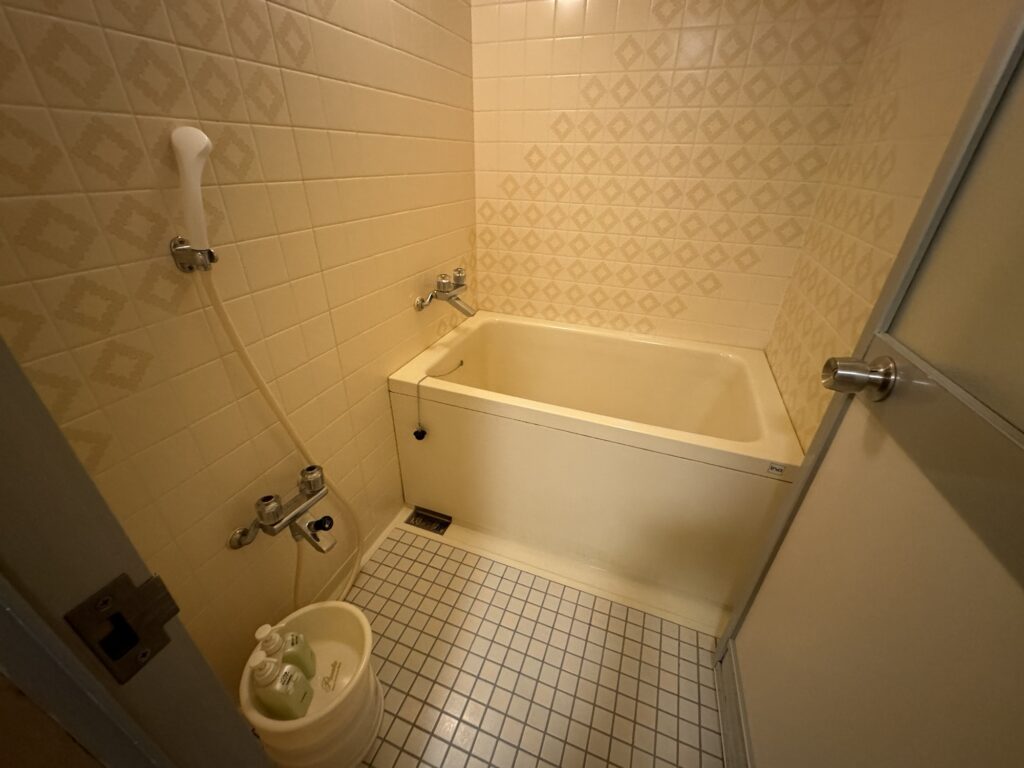
The room has a bath too, but when you come to a hot spring inn, the large public bath is the main attraction, right?
In size it’s quite small, so rather than soaking properly to ease fatigue, it’s better to accept it as being for a quick morning hair wash.
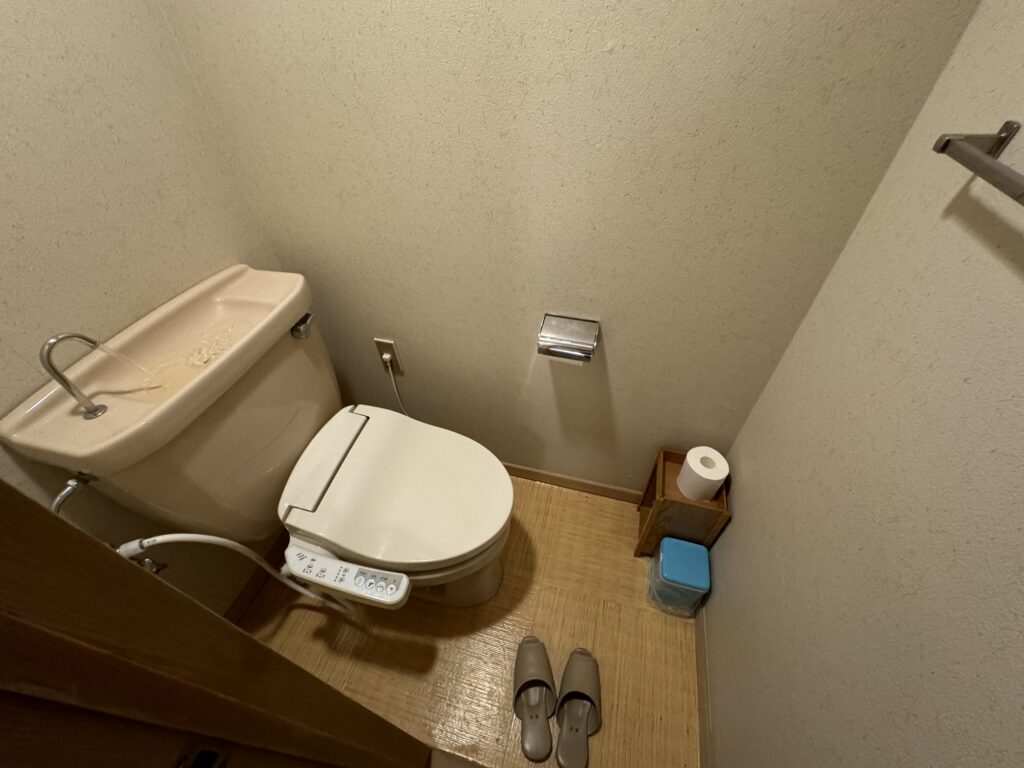
The toilet is also a point worth checking carefully, and here it has a bidet seat, which is reassuring!
The space itself is spacious and clean, so it doesn’t feel cramped at all.
And a trash can is properly provided, something easy to overlook, so you won’t have trouble throwing away small bits of trash.
Large Bath and Open-Air Bath at Ikaho Onsen Nyoshin no Sato Hibikino
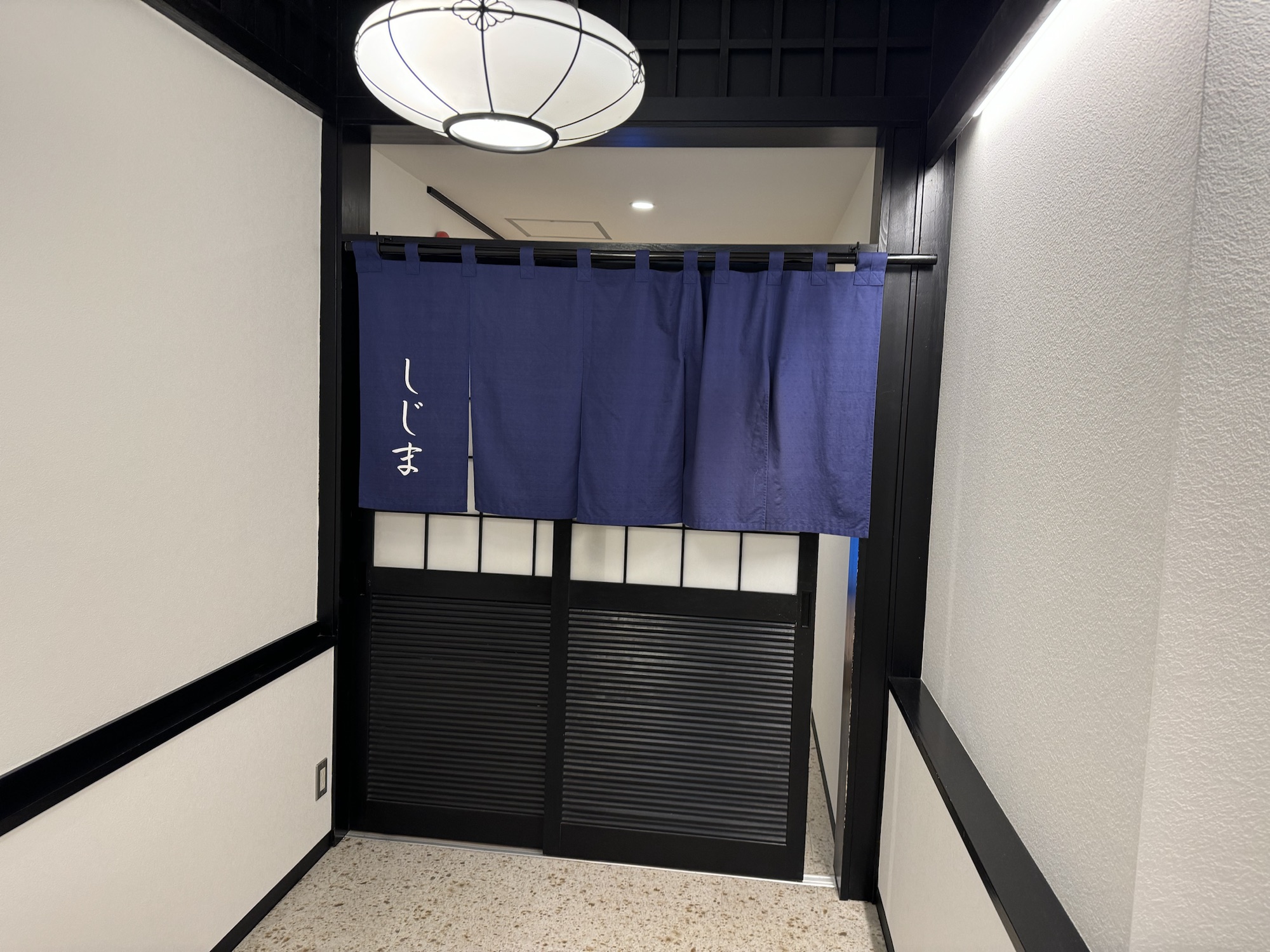
Now, the main event!
The hot springs at Ikaho Onsen Nyoshin no Sato Hibikino let you luxuriously enjoy two kinds of source water, free-flowing, the “Kogane no Yu (Golden Bath)” and “Shirogane no Yu (Silver Bath),” rare even in Ikaho.
Because it was just renovated, the large bath is stylish and spotlessly clean.
The changing room is spacious and easy to use, and as soon as you step inside, a modern, refined indoor bath welcomes you.
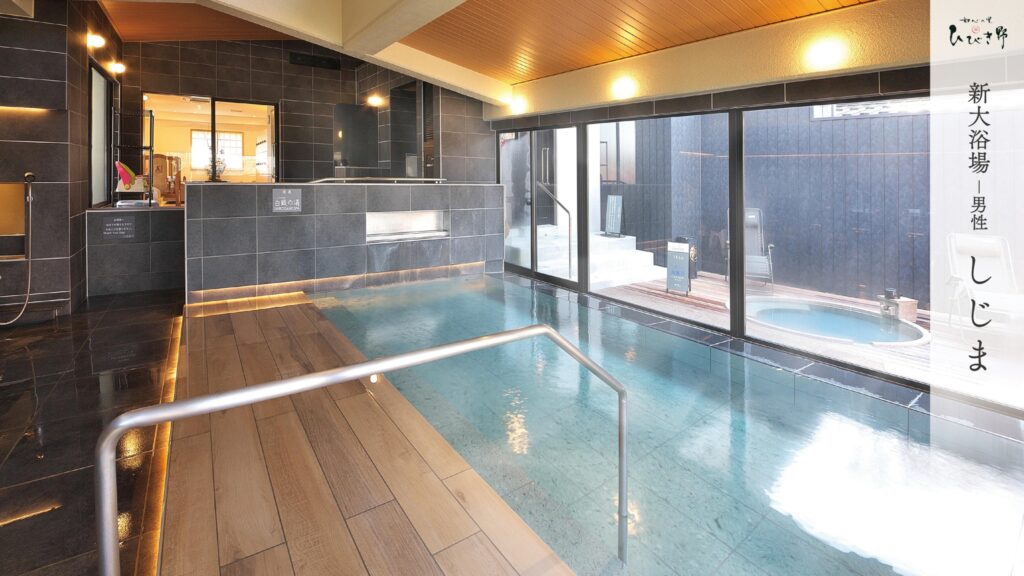
The men’s indoor bath is the “Shirogane no Yu (Silver Bath),” colorless, clear, and smooth to the touch.
The water volume is plentiful above all, and the sight of the wide tub filled to the brim is overwhelming!
This “Silver Bath” is set at a slightly hotter temperature than the “Golden Bath” in the open-air bath, so it feels great to first warm your body up crisply in the indoor bath and let the spring components soak into your whole body.
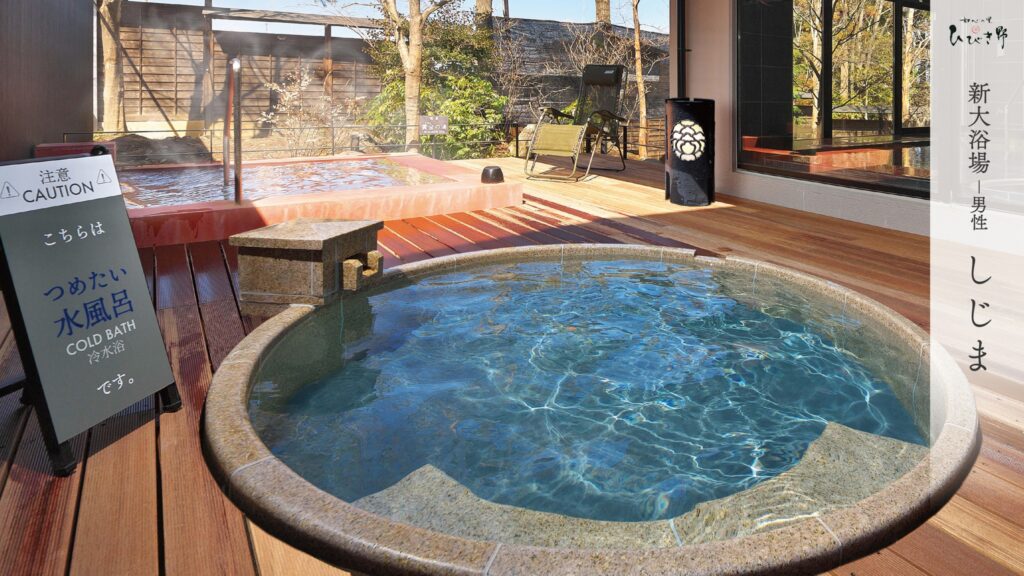
The men’s open-air bath also has a cold plunge called “Shijima.”
However, the temperature of this cold plunge isn’t regulated, so in winter it’s truly “ice water” level cold! It’s irresistible for sauna lovers and anyone who enjoys contrast bathing, but be prepared for coldness that could stop your heart.
On winter nights, the wet floors freeze and become slippery, so really watch your step!
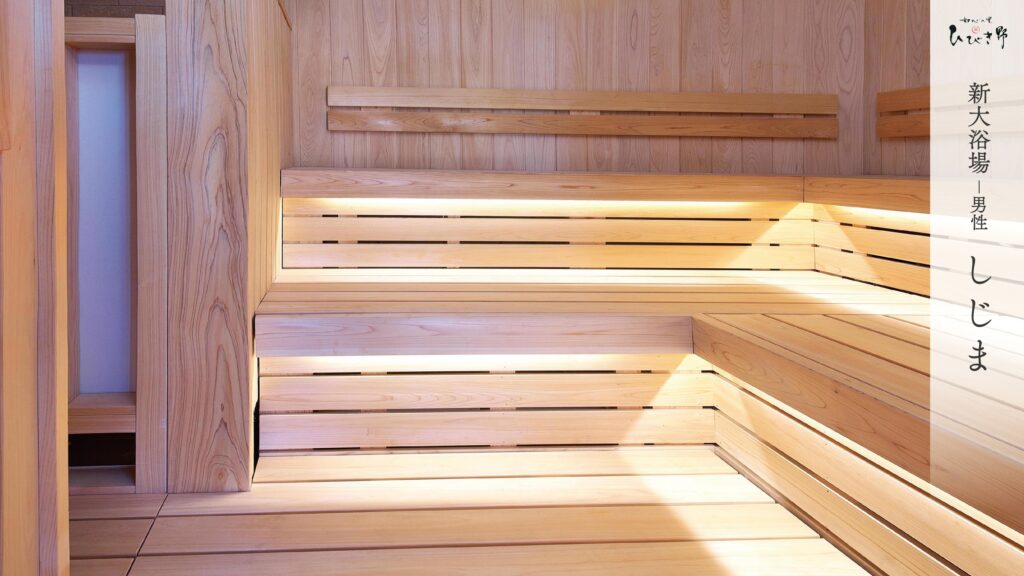
Saunas at inns in Ikaho Onsen are surprisingly rare, but Hibikino is properly equipped with an authentic high-temperature sauna.
The sauna room is a compact L-shaped, two-tier design with a capacity of about 4 people.
But what stands out is its temperature setting! At a very high 95°C to 100°C, you can work up a strong sweat in a short time.
After a thorough steaming in the sauna, head straight to that open-air cold plunge that’s “like ice water in winter”…
This extreme temperature difference may be the Hibikino way’s shortcut to the ultimate “totonoi.”
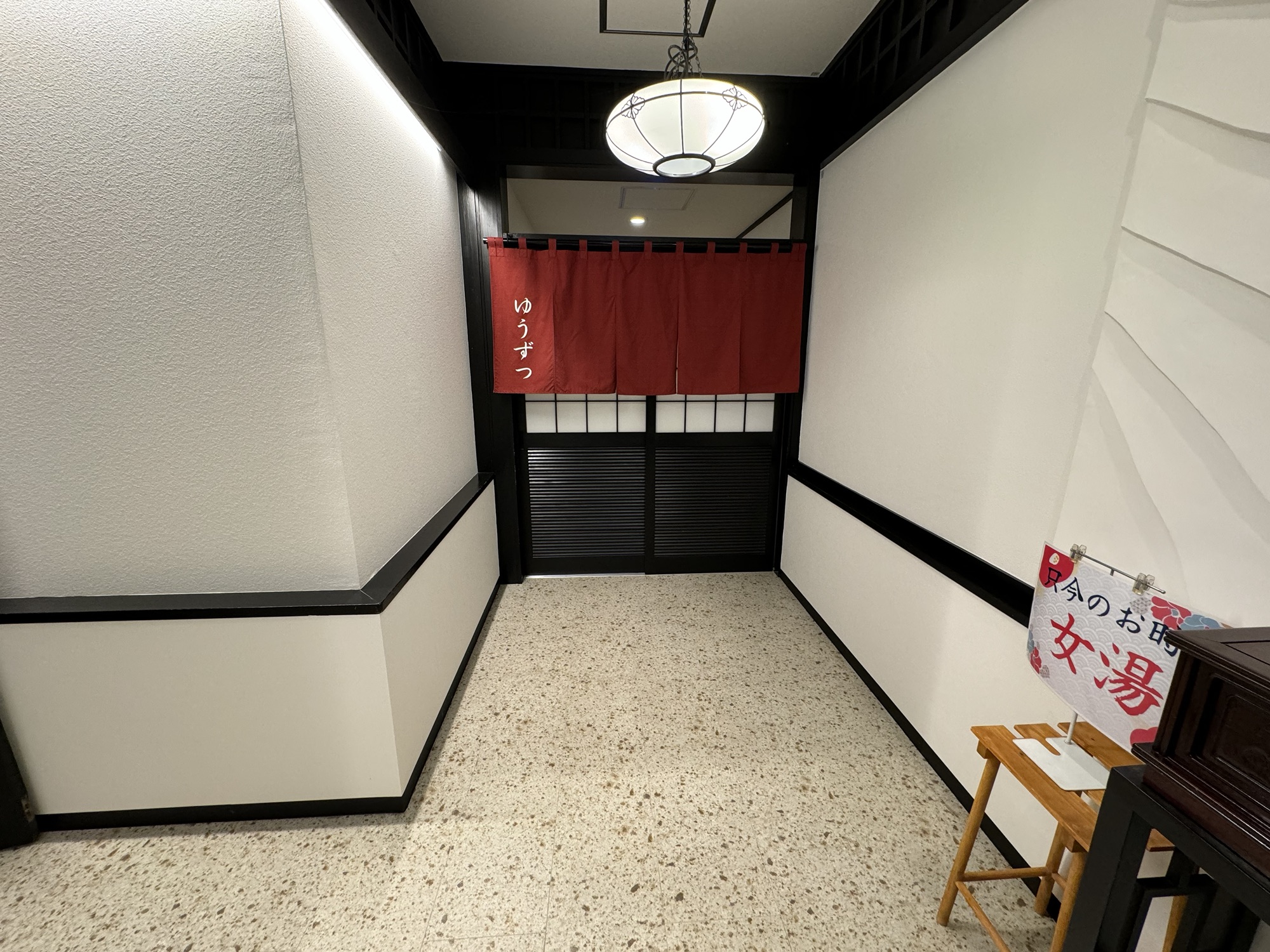
The women’s large bath has the atmospheric name “Yuzutsu.”
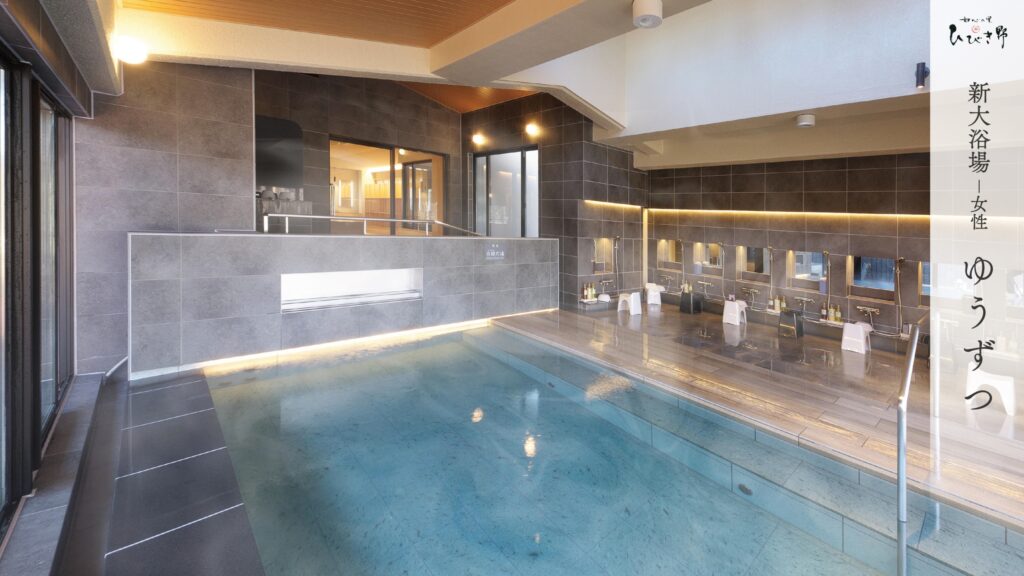
The women’s indoor bath is the same “Silver Bath” as the men’s. The washing stations line the back wall.
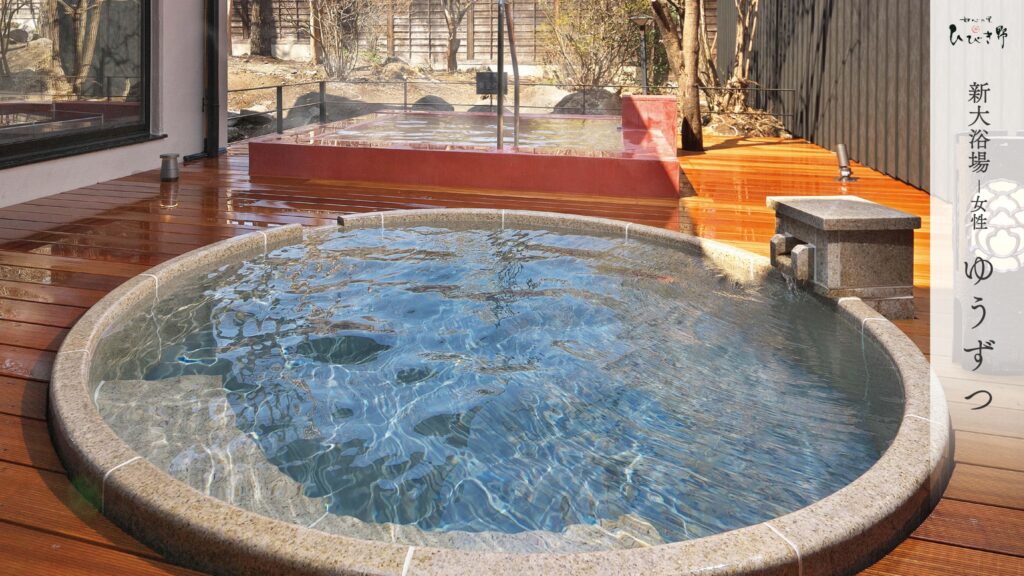
The women’s open-air bath also has a round rock cold plunge.
A sauna is provided for women as well, so sauna fans can definitely enjoy it to the fullest!
Dinner at Ikaho Onsen Nyoshin no Sato Hibikino
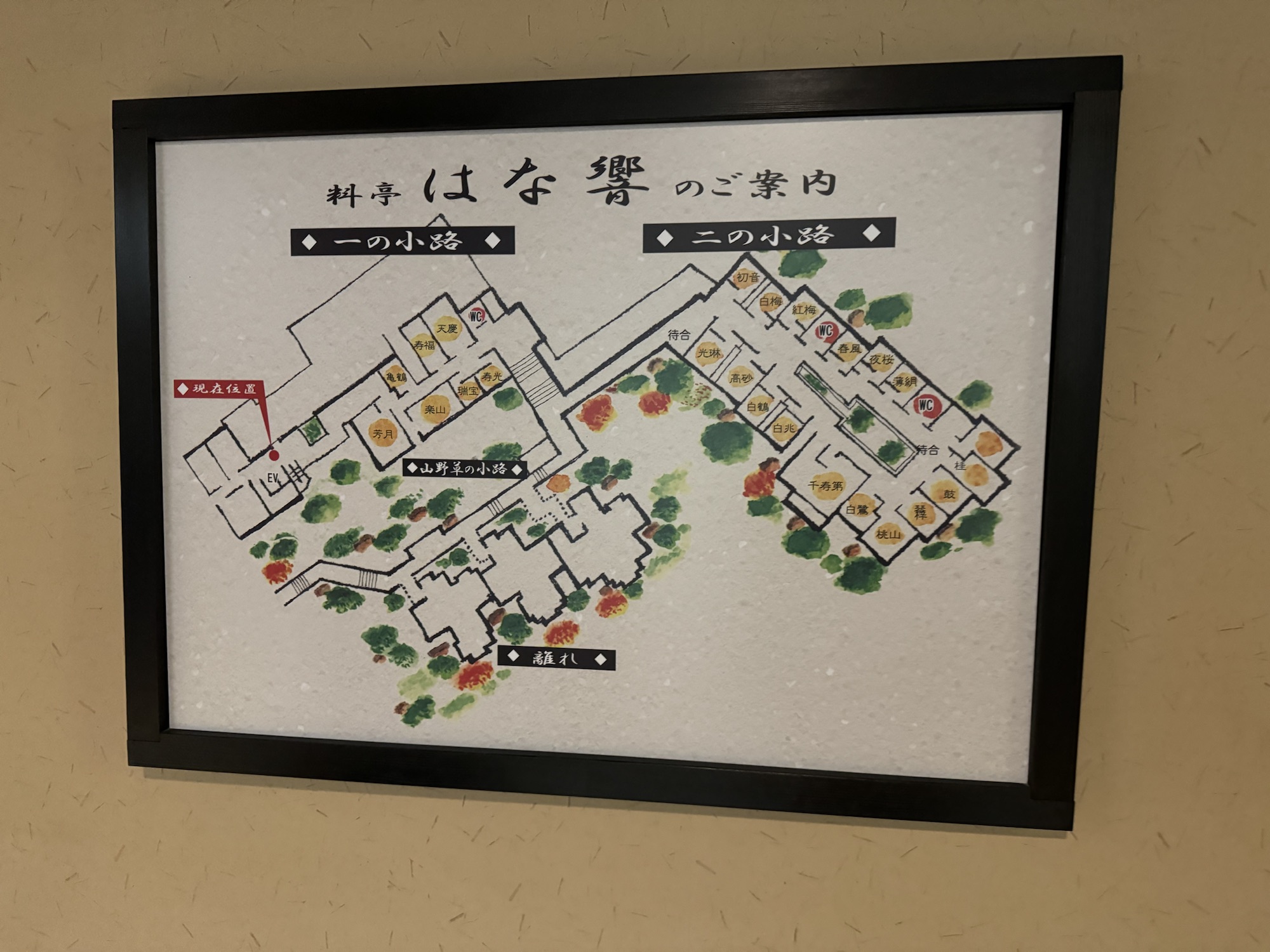
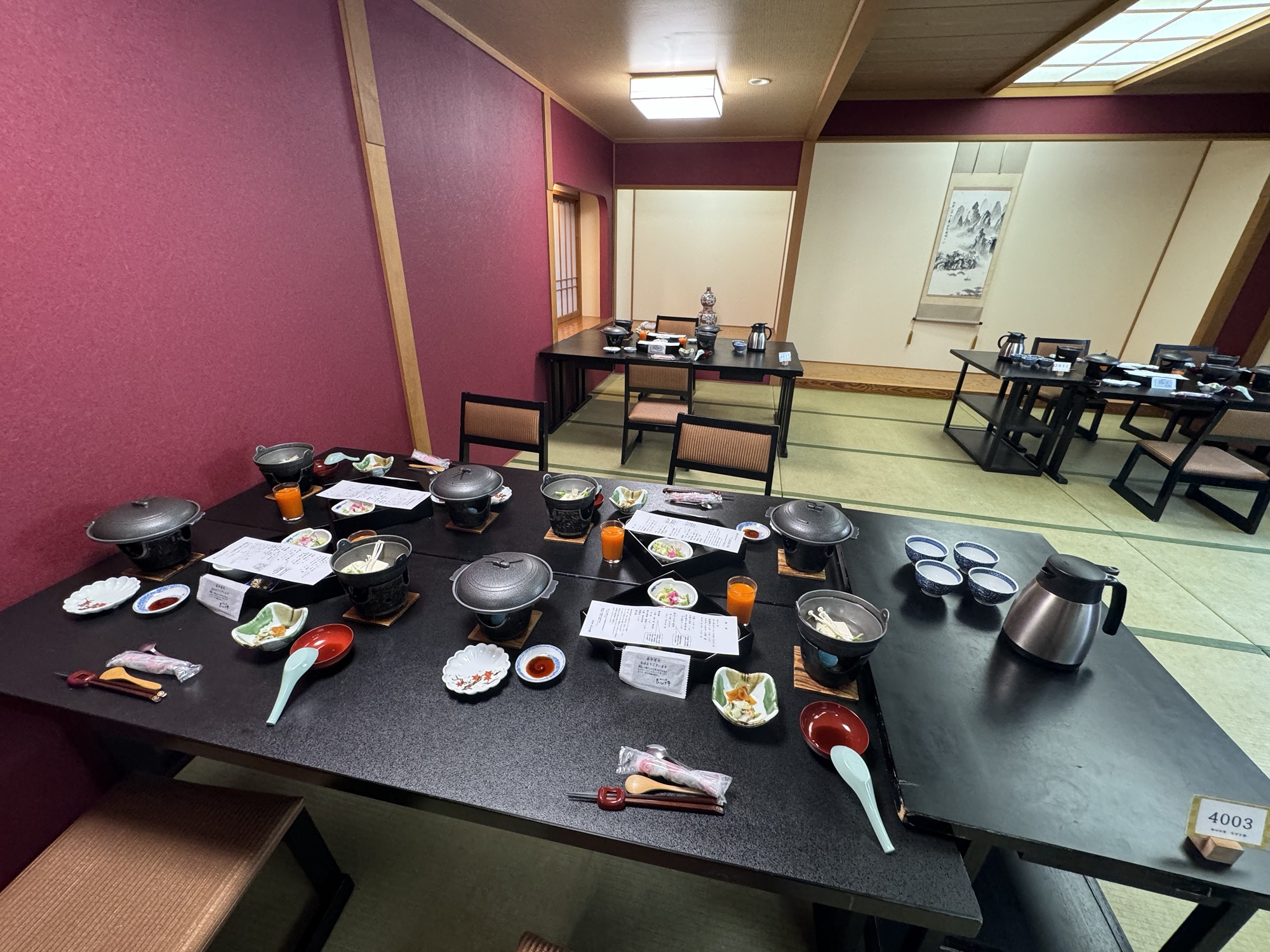
Dinner at Ikaho Onsen Nyoshin no Sato Hibikino is guided to a semi-private room at the restaurant “Hana Hibiki.”
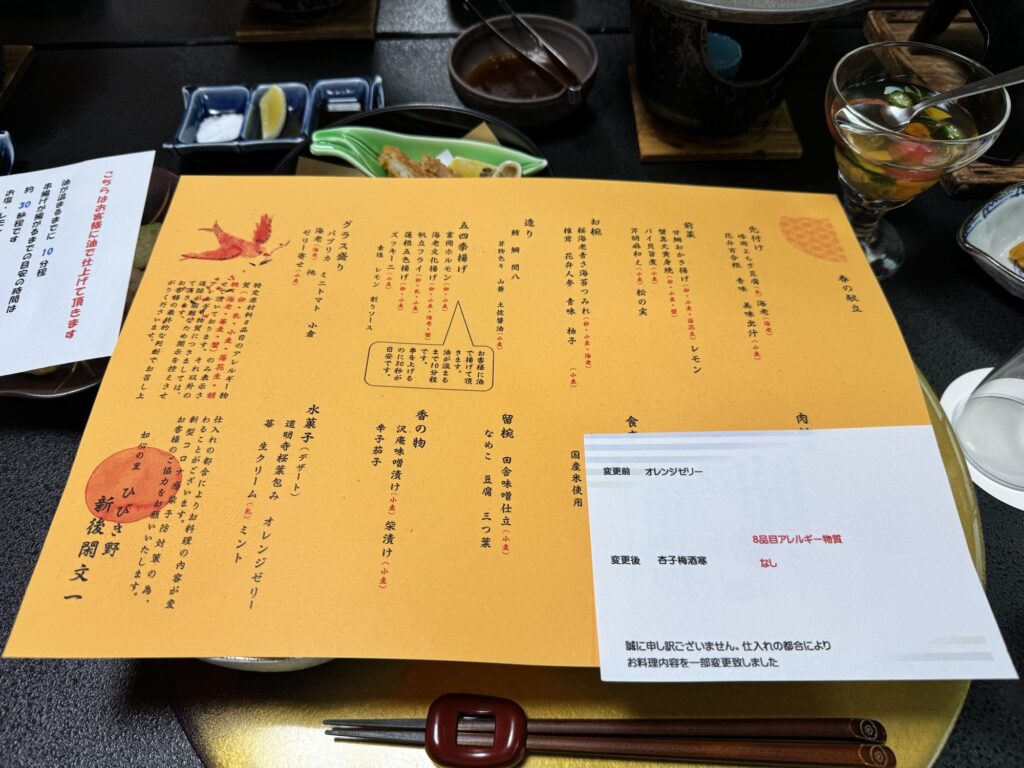
When we sat down, there was a dinner menu.
The menu lists: starter (sakizuke), appetizers, clear soup (owan), sashimi, five-season fry (goshiki-age), a dish served in a glass, meat dish, rice dish, miso soup, pickles, and fruit.
Isn’t that too lavish?!
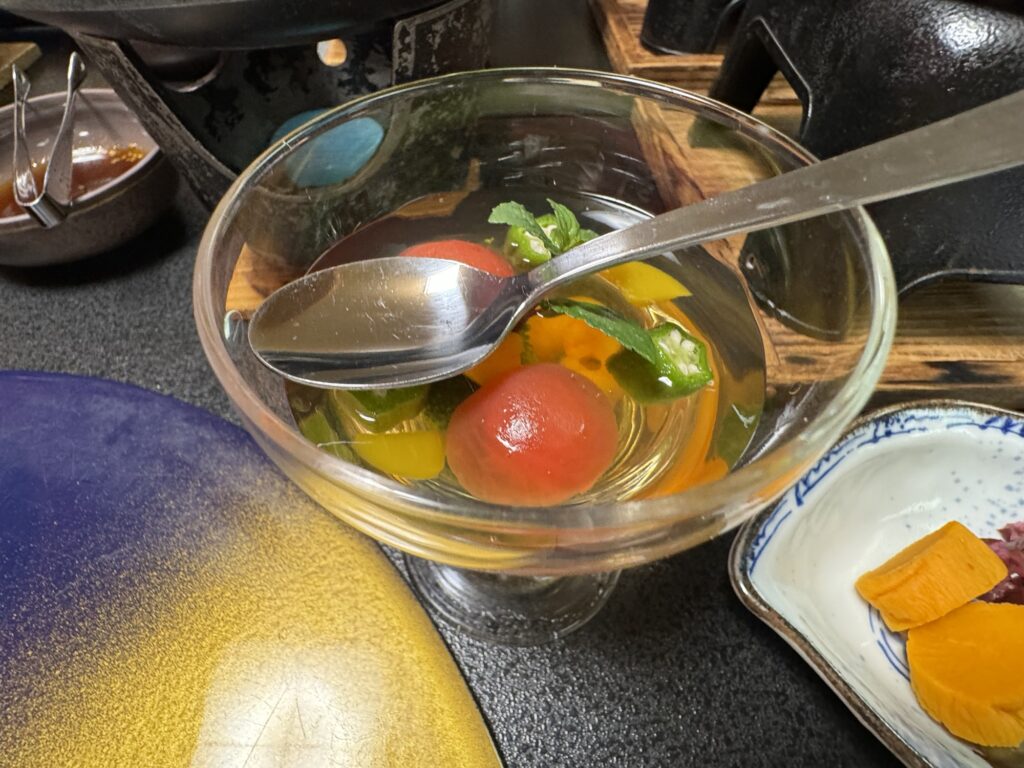
A jellied salad with bell pepper, cherry tomatoes, sweet red bean paste, shrimp, and more. Stylish.
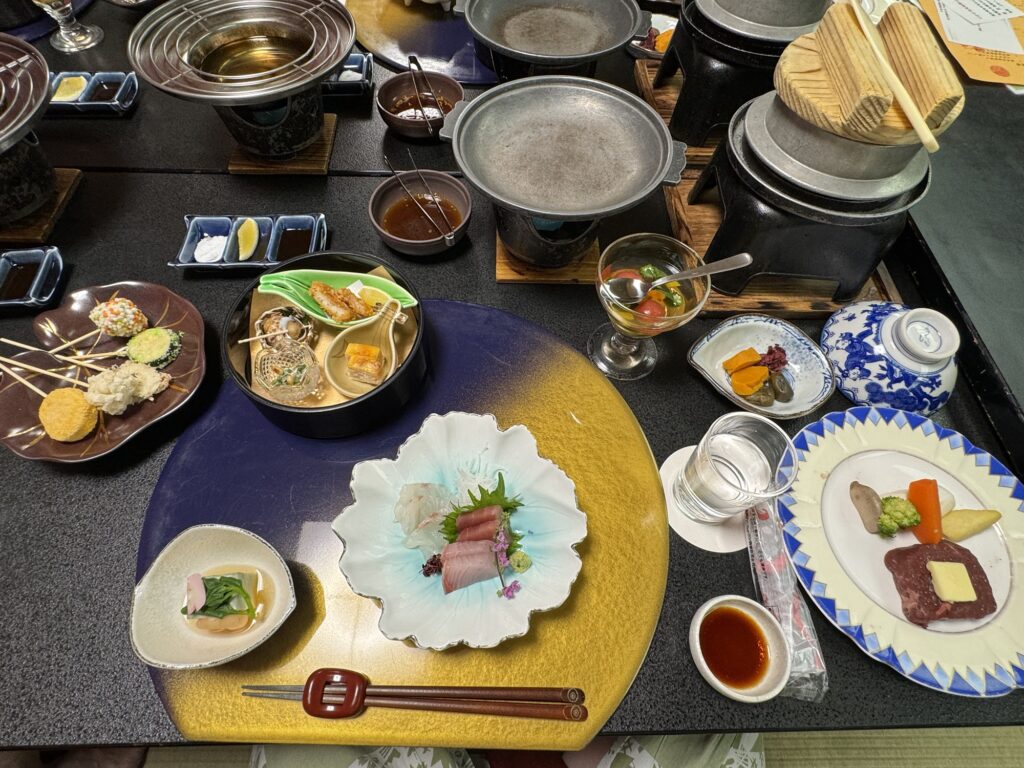
In the center are the appetizers, sashimi, and starter.
The appetizers are tilefish okaki fry, crab shinjo with grilled egg yolk, simmered baigai (whelk), and sesame-dressed pine nuts,
The sashimi is a three-piece assortment of tuna, sea bream, and amberjack.
The starter is Mineoka mugwort tofu. Every one is a carefully made specialty.
I doubt many people have eaten baigai (whelk).
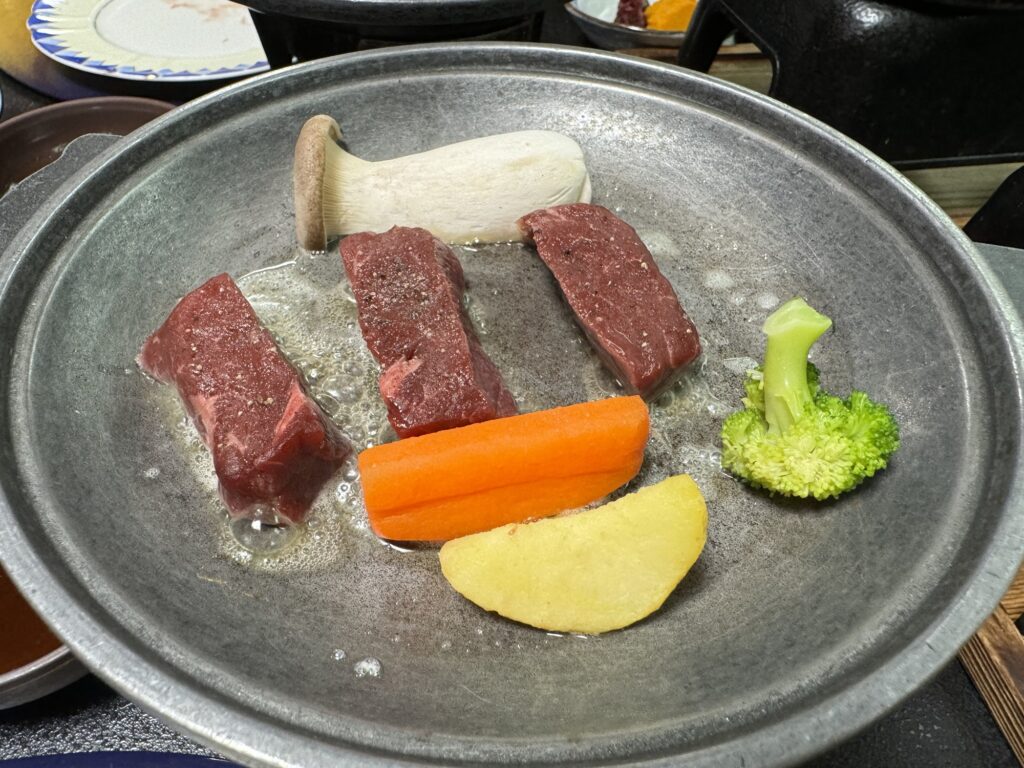
One of the meat dishes is Joshu beef steak grilled on a ceramic plate.
One piece each of king oyster mushroom, broccoli, and carrot as vegetables, and one potato too.
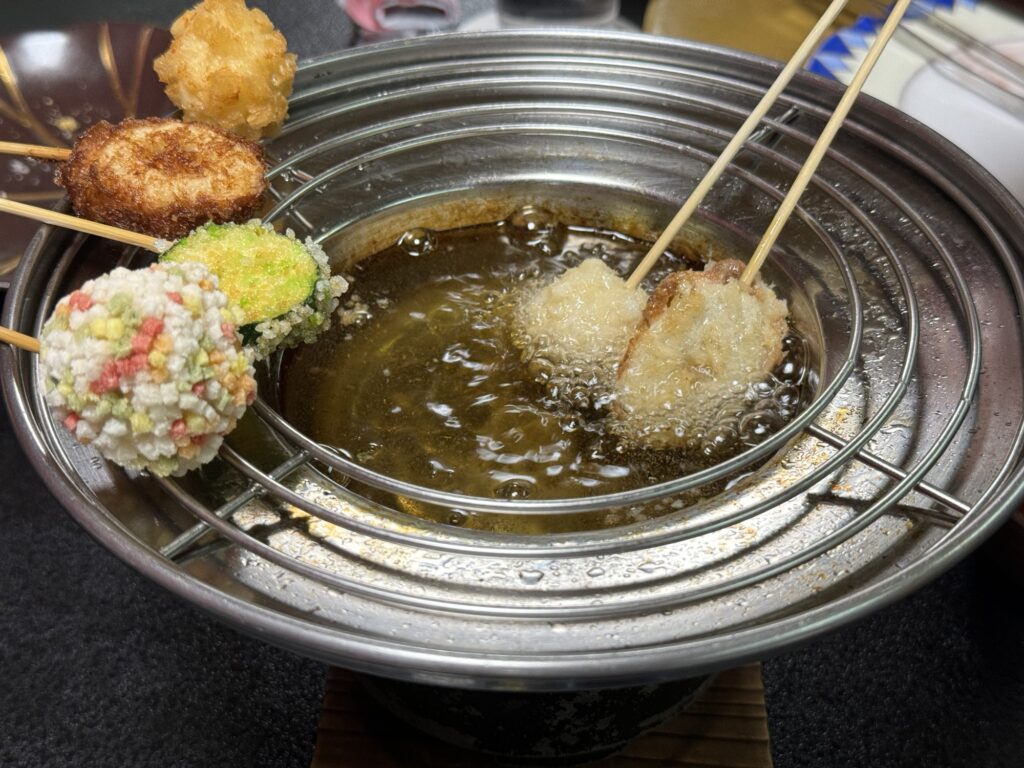
The five-season fry is a style where you fry it yourself in oil and eat it.
If you warm the oil for about 10 minutes beforehand, it cooks up crisp in 30 seconds.
The five skewers are Tomioka horumon, shrimp bunka-age, scallop fry, lotus root five-color fry, and zucchini, and you can season them freely with salt, lemon, or a mixed sauce.
Breakfast at Ikaho Onsen Nyoshin no Sato Hibikino
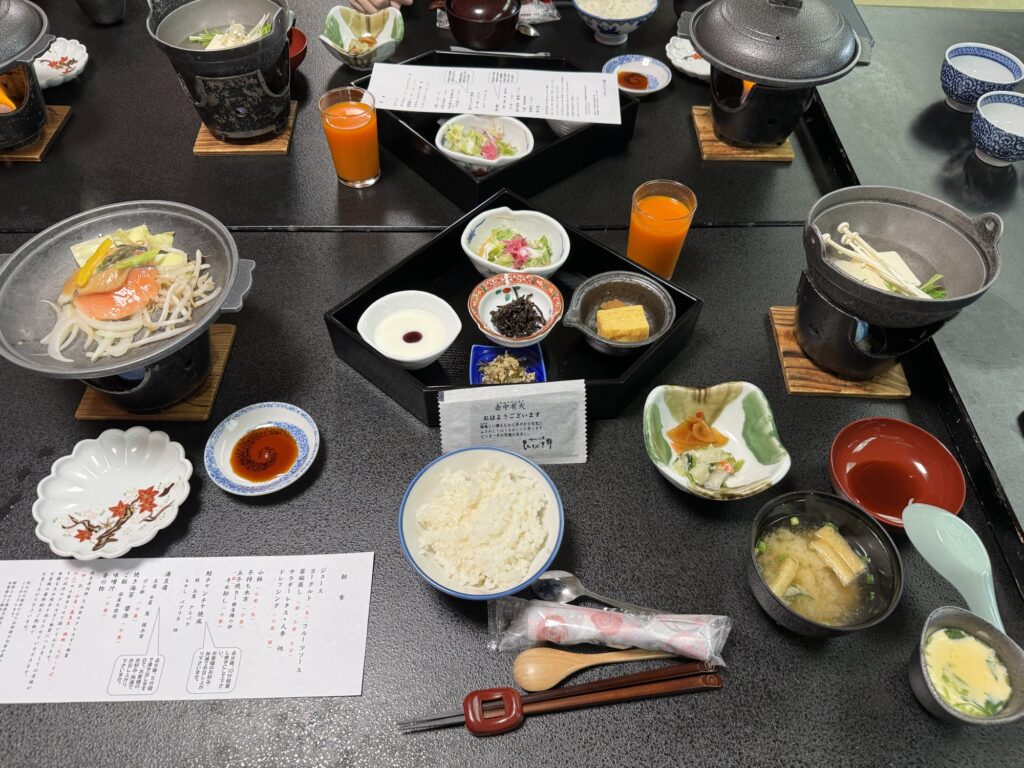
Breakfast at Ikaho Onsen Nyoshin no Sato Hibikino is also in the restaurant “Hana Hibiki,” the same venue as dinner.
The menu is small side dishes, kikurage with roe, tamagoyaki (with eggs from Haruna chicken), grated daikon, salmon chanchan-yaki style, yudofu, grilled nori, rice, miso soup, pickles, juice, and yogurt.
It isn’t as lavish as dinner, but unlike a breakfast buffet, you can enjoy the meal at leisure, which is nice.
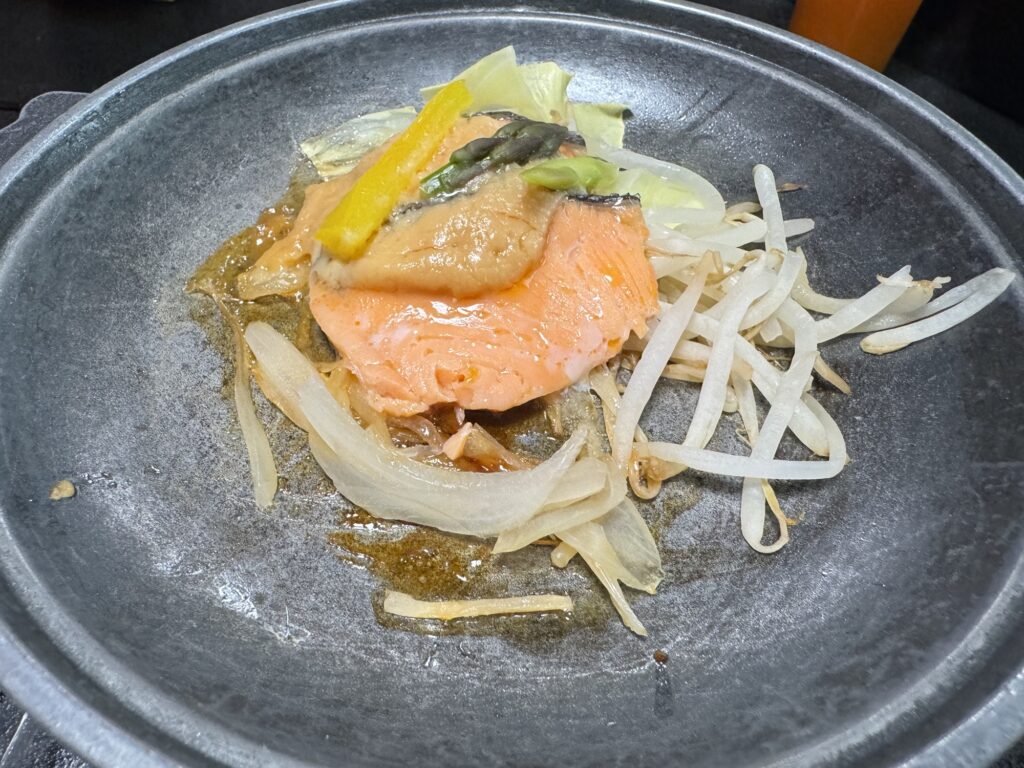
Please eat the salmon chanchan-yaki after sizzling it on the iron plate.
The richness of the miso and the umami of the salmon fill your mouth, and this is delicious!!
My Impressions of Staying at Ikaho Onsen Nyoshin no Sato Hibikino
This time I chose Ikaho Onsen Nyoshin no Sato Hibikino as my lodging for sightseeing in Ikaho!
It had a high Rakuten Travel rating of about 4.2, so I stayed, and it was exactly the image of an Ikaho hot spring inn, and being able to enjoy two kinds of Ikaho Onsen water at once is a plus.
It also has a dry sauna that sauna fans will like, and you can get your “totonoi” with the open-air cold plunge and reclining chairs.
The Joshu beef steak grilled at dinner was also tender, juicy, and delicious.
It’s a hot spring inn I’d like to revisit.
Now then, let’s go Trip & Happiness♪

コメント